[music] Hello and welcome back to the ILO's Future Of Work Podcast. I'm Sophy Fisher. [music] For months now, the world has been focused on a basket of global intersecting crises, including inflation, price rises, energy conflicts, and the effects of climate change. To some extent, this has deflected attention from some critical longer-term issues.
One of these is human trafficking. Trafficking is, of course, closely associated with forced labor and modern slavery. The 30th of July is World Day Against Trafficking, so we thought this would be a good time to talk a little bit about the changing picture of human trafficking in the light of all these current crises. With me to do this, I'm very pleased to have Alix Nasri, who is ILO technical specialist on forced labor, and Lela Tolajian. Lela is a human rights activist and the founder
of the International Coalition Against Modern Slavery. She's also working with the campaign against modern slavery organized by ActionAid, which is a global federation working against poverty and injustice. Alix and Lela, welcome to you both. Thank you so much for joining us. Thank you so much for having us. Thanks so much for having us. Alix, let me start with you. The last three or four years seem to have been driven by crises. We've had the COVID-19 pandemic.
Now we have inflation. We appear to have migration on the increase. We seem to be having the consequences of climate change. You are one of the ILO's experts on trafficking. Do you have any idea of how this has changed the picture and what the latest trends are? Thanks, Sophy. Yes. In fact, at the ILO, we do what we call the global estimation. Those global estimation are focused on forced labor. It shows really, unfortunately, a trend in terms of increase.
The last global estimation we've been doing was in 2016, and we've done another one in 2021. We chose an increase of 2.7 million in the number of people in forced labor situations, which would mean 3.5 per 1,000 people in the world that are in situation of forced labor. Showing that, in fact, the situation is not improving, and today we still have a big problem at our hands with a total number
of 27.6 million people in situation of forced labor on any given day. It's really great to be talking about it today to discuss a bit more what we can do to really accelerate progress, which is absolutely needed when we look at those trends. That's all a bit depressing, those figures. Do we have any idea of who is affected geographically or in terms of the kind of people? Yes. Our global estimate shows that no region of the world is spared from forced labor.
If you take the total number of people, Asia and the Pacific is host to the highest number of victims, 15.1 million. Then if you look at the prevalence of forced labor, it's in the Arab states region where the prevalence is the higher, but all region is really affected. Men, women, children. Women and girls make up to around 11.5 million of the total number of people in forced labor
and more than 3.3 million children are in forced labor. This is really a global problem. I think one interesting trend that it also shows compared perhaps to other issues that the ILO is dealing with is that really forced labor happen in countries with high income, with middle income, with low income. It's really everywhere, which shows that we need to have really a comprehensive approach and specific approaches also depending on the type
and forms of forced labor. Lela, let me bring you in here as well because I think you've done some work on the gender disparities in trafficking. Is that right? Yes, absolutely. Trafficking fuels violence against women at a much higher level than it fuels violence against men because we see women globally have less access to education and to job opportunities. Then this economic and physical insecurity places women and girls in desperate situations where they're more likely to have to pursue risky opportunities and be deceived by traffickers.
We can see this reflected in the data. In 2022, for example, for every 10 victims detected globally, 4 were adult women and 2 were girls. We've seen that 99% of the victims of forced labor in the commercial sex industry are women and girls. They also make up 58% of the victims of forced labor in all other industries and constitute 84% of the victims of forced marriages. We can see human trafficking is overwhelmingly affecting women, especially women who are migrants, who are living in poverty, who are living in the Global South who are affected
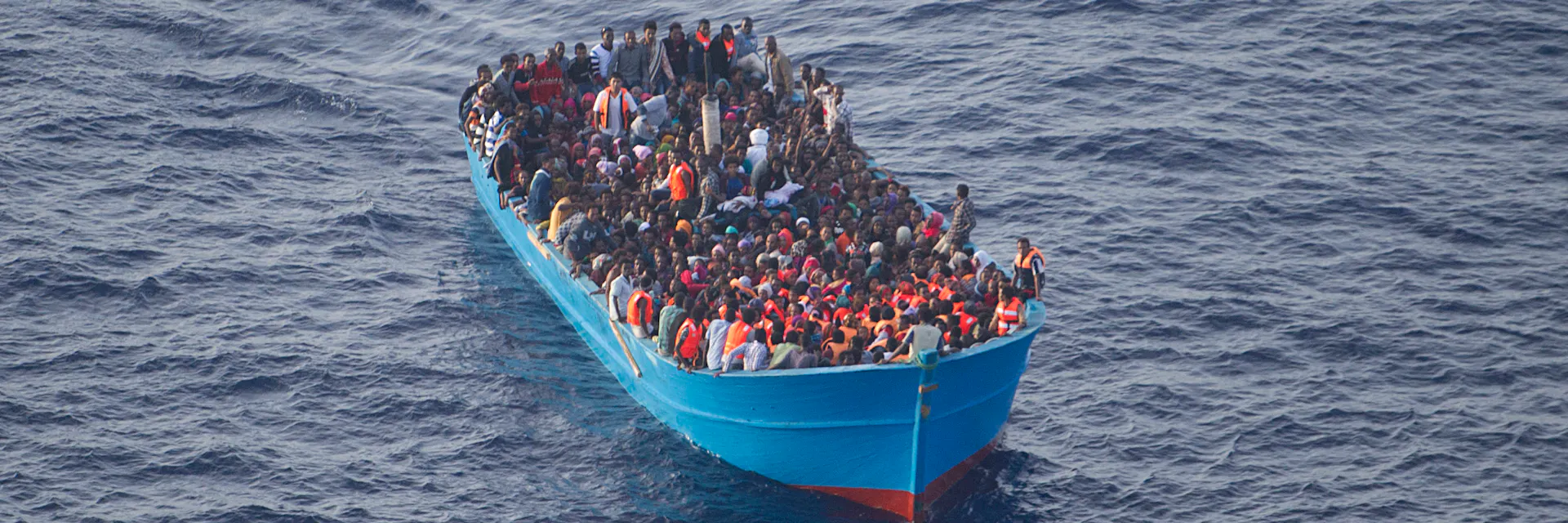
by the climate crisis much more than people in other communities. Right. What about other marginalized groups? Do we have any information about how they might be affected? Yes, absolutely. Migrants as a whole are much more vulnerable to being trafficked. We've seen that the International Office of Migration found that 70% of migrants traveling to Europe via North Africa have been trafficked or exploited in some way. This is especially for migrants who are undocumented who are fleeing violence, who don't have access to support systems
and the privilege of taking regular migration routes. Right. Basically, as soon as you start migrating for reasons of poverty or climate change or whatever, you automatically make yourself more vulnerable to human trafficking. Would that be a fair assumption? Absolutely. We've also seen that when there are not a lot of support systems to help migrants, a migrant can come to a country and they can make it to a country, but all of a sudden, because they're not documented, they're not allowed to work legally. They are forced to work illegally to survive, to feed their families,
and they're much more likely to be exploited by traffickers. Then they cannot go to law enforcement for help, they can't seek resources because they're not documented. Right, so it's a downward spiral. Let's try and move this forward onto a more constructive note and talk a bit about prevention. What are some of the key things that can be done to prevent human trafficking and modern slavery? Alix, let me start with you on that one. Thank you, Sophy. Prevention is absolutely key.
This is one of the big focus of ILO's protocol against forced labor. I would say the first thing is really to look at how are workers protected by the labor legislation, so really ensuring that all workers have their labor rights guaranteed. For some categories of workers today, this is really not the case. When you look at sectors like domestic workers, fishers, or others,
still today they have unequal labor rights. They are excluded from the coverage of the labor legislation. The first basis is really for governments to ensure that all workers are well protected in terms of their labor rights. Secondly, we're also looking at issues of ensuring that workers are recruited fairly, and this goes quite along the migration situations because we've seen
that when workers do not go through a fair recruitment process, they have much more chances to then fall into a situation of forced labor. It's important to focus on ensuring fair recruitment of workers so that then they have much more chances to be in decent work, including by ensuring that labor migration legislations are fair, that workers are not collected recruitment fees for their recruitment so that they're not in debt bondage afterwards
having to reimburse those debts for a very, very long time that do not allow them to quit the job. Ensuring that workers go through the recruitment process with a clear contract with clear terms and conditions of the contract and that they are not deceived because then it can be also difficult to leave a situation where you have been sold dreams at the recruitment stage, and then you discover that the situation at work is not the same. Another area of work is also to focus on due diligence.
We are at the ILO trained to support the public sector and also the private sector is ensuring adequate due diligence and looking at how forced labor can be prevented and addressed. That's also a very important focus. Maybe a last one. There are several, but it's really to try to also strengthen labor inspection systems so that forced labor can be detected,
trafficking in person can be detected, and then a possible victim should be referred to different systems. Another thing that we also look at at the ILO in terms of this prevention is that there are a lot of root causes of forced labor and trafficking in persons that are linked to, for example, very low unionization rates in certain sectors, very informal sectors where, for example,
workers do not have any contracts, do not know very well the terms and conditions of employment. There are also some links between forced labor and some other fundamental rights. One key aspect of work is to see how to address those root causes and supporting unionization, for example, campaigns of workers in very informal sectors by looking at also migrants in those sectors. That's a few examples, Sophy.
It sounds like properly structured migration would be a major step forward, properly structured and properly organized migrations systems so that people coming from one country and looking for work in another could do so in a legitimate and transparent manner. That's absolutely key to ensure safe migration processes, which means that migrant workers can migrate through regular channels
with less risk of exploitation in the process. For example, ensuring that migrant workers only go through licensed or registered private employment agencies. Making sure that in all the countries of origin, they are not collecting any recruitment fees and that the legislation prohibit this. I think at the same time, we realized that sometimes workers are still being exploited through regular channels. The first priority is of course to regularize and regulate,
and then also look at how to enforce adequately so that when you have the proper regulation, this has an impact. Yes. Now, we talk a lot on this podcast about the impact of technology on the world of work. I know one of the areas that it's impacted obviously is migration because it involves the passage of information between one country and another. I'm wondering whether there's also a role for technology now
in combating trafficking in some way. Lela, let me ask you about that. Do you see a role for new developments in technology in alleviating this problem? Yes, absolutely. With technology, it's important to note that technology has both fueled human trafficking in some cases, but also provides a great resource to prevent it. For example, we've seen traffickers who have used technology to send out advertisements saying they have a job.
If the person wants to come to a location or pay them some amount of money, there'll be a fair job with a good wage for them. This is sent out to many, many people through the use of technology through online messaging forums. Then if people come and take these jobs, oftentimes they're trapped in situations of debt bondage, they're trafficked, they're forced to work with no pay. We've seen traffickers utilize technology to reach more victims, but technology also has a lot of great abilities to prevent and to reduce human trafficking. For example, many of the companies we use and buy from every single
day have forced labor along their supply chains. They're sourcing from the labor of people who have been trafficked and forced to work with no pay. With blockchain technology, if companies utilize this, they can better track their supply chains to ensure that no forced labor, no traffic labor is happening along their supply chains. That's really, really important. Technology can also be used to raise awareness about human trafficking because, again, a lot of people maybe don't understand that certain jobs or certain false advertisements can lead to being trafficked.
A lot of people don't know the signs of human trafficking, so using technology to share about that, to share hotlines is also really important. It's also great to rehabilitate survivors providing resources digitally, connecting with therapists, connecting with things like that. Technology has a lot of great uses for helping organizations who work to help rehabilitate survivors. Alix, would you agree with her? Yes. There's definitely great potential, but it needs to be really targeted,
I would say so. For example, what we are also trying to do right now in the ILO is to look at some of the sectors that are more at risk of trafficking in persons. Fishing, for example, is one of them. We've been trying to explore and map all the digital technologies that exist or that are in development to track forced labor onboard fishing vessels worldwide. To try to see then how this information could be helpful to some of our constituents
like labor inspectors in targeting better inspection to detect forced labor. I think there's really a need to look at those different sectors and how technology can be applied. I think there's also a big need to bridge the divide between governments, law enforcement, social partners, and those digital tech actors because sometimes they don't speak the same language. Sometimes those technologies are developed completely out of the blue without really workers
and potential victims at the center. We are really trying to bridge this gap in everything we do. We are seeing some really interesting technologies being developed. For example, also technologies that would provide access to complaints mechanism online on your mobile phone, on the internet to victims that might be extremely isolated and that are used, for example, by trade unions worldwide. Yes, initial I would say very interesting application,
but with the need to continue to look at this and see really how they can be helpful. Technology will not replace the people who do prevention and support access to justice of victim but it can help. Actually, you've raised a point there which I was just going to come onto, which is that people often think of human trafficking and forced labor as a law enforcement issue and something that should be dealt with by the police or other law enforcement bodies. From what you say, there is also a pretty important role
for not just governments but also workers and employers organizations in combating trafficking and forced labor. Is that right? Absolutely, Sophy. Yes. Indeed, it is very important to ensure that victims have access to justice and that there is prosecution of traffickers, but there is also a bigger role and stronger focus on how can we prevent this from happening in the first place.
Here on prevention, governments, trade unions, employers organizations, and their members have a huge role to play. Governments not only on law enforcement with strengthening labor inspection system to detect trafficking in persons but also to regulate well, to regulate safe migration, to regulate private employment agencies, to regulate, in fact, all the root causes that could enter into the picture.
As I was mentioning in the beginning, ensure that, by law, all workers are covered by the labor legislation. In terms of the role of trade unions, obviously, they have a big role to play and they have been playing a big role in sensitizing workers about the risks in migration situation, for example, also pre-departure risks, but also playing a role in addressing some of the root causes. Ensuring that workers are well represented even in the informal sector,
for example, is really key. Business on the other side is absolutely central to this, including by conducting due diligence of recruitment practices and looking at also more broadly issues around forced labor and trafficking in person in their supply chains. Lela, what about individuals? Because a lot of people feel very engaged
with the issue of human trafficking and forced labor, but as individuals, they may feel that there's nothing that they can do, they have to leave it to the structures of society and government. Is there anything that individuals can do about this? Oh, absolutely. Like you said, looking at the issue as a whole, it's really so overwhelming with human trafficking being the fastest-growing crime worldwide. It feels like there's nothing individual people can do, but in reality, there's a lot. One big thing is for everyone to be aware of the way traffic labor exists in global supply chains,
to pay attention to which companies have been found to not verify their supply chains, to source what has been fished, farmed, produced by forced labor, and which companies are taking steps to ensure that all of where they source from there's ethical labor. People are being paid a fair wage, no one is being exploited. By making people aware of this, make people switch into making more ethical purchases, we can put pressure on companies to improve labor rates in their supply chains, and then that reduces the demand for traffic and for forced labor,
and allows more people to be paid decent wages. It's also really important to get involved in local political organizing. You could see are there resources for victims of human trafficking in your area, what are the support systems available? What are the support systems for migrants, for undocumented people? Really trying to strengthen the laws on a local level to protect vulnerable groups, that's also super, super important. I think what we said earlier that be aware that forced labor
exists in every single country in the world. It's just not simply a phenomenon of lower and middle-income countries. Absolutely. Especially in the US, we've seen a lot of forced labor trafficking of migrants, especially in the agriculture sector and in construction sector. It's really, really something to be aware of because a lot of people just think this exists on another country, on another continent, it's not happening in my own country, my state, my backyard. Fully agree with Lela that I think people have in their mind
very traditional forms of exploitation and don't realize that, in fact, people may be victims of trafficking really across the corner. It affects really very different sectors. It's important to really raise awareness about what constitute trafficking in person and really encourage also people to have a better understanding of those more modern forms that exist around us.
Okay. Look, we have to leave it there, but that's a great point to end it on. Lela and Alix, thank you so much for your time. That's Alix Nasri of the ILO and Lela Tolajian of the International Coalition Against Modern Slavery. Thank you to you, the audience, for listening to this ILO Future of Work Podcast. Please join us again soon and goodbye for now. [music]