Good afternoon and welcome to the ILC conversations, which this year is brought to you by the Future of Work podcast series. We're coming to you from the ILC, the 113th International Labour Conference here in Geneva, where every day we explore a special topic. And today we're talking about the Maritime Labour Convention. I have a question for you. Where do you think the clothes that you wear? How are they transported? The houses that you live in, the material that builds them.
How is how is the material transported? The food that you eat, the petrol that you use. How is it all transported? Well, you'd be surprised to know that 90% of it is moved by sea. And this is because seafarers work very, very hard in order to ensure that your goods and your services are delivered every day. And this is why the Maritime Labour Convention is so important. So we're here today to discuss the MLC or the Maritime Labour Convention. It's mechanisms, we're often told,
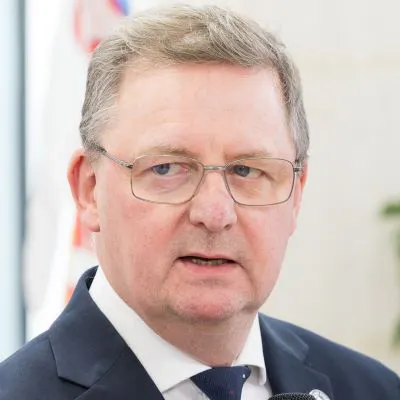
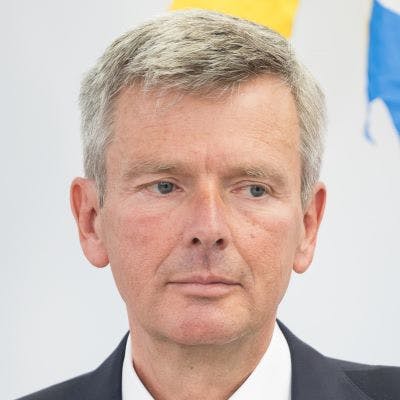
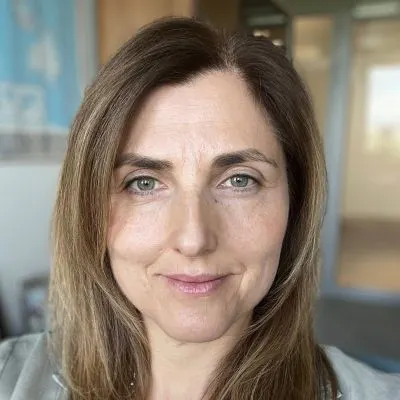
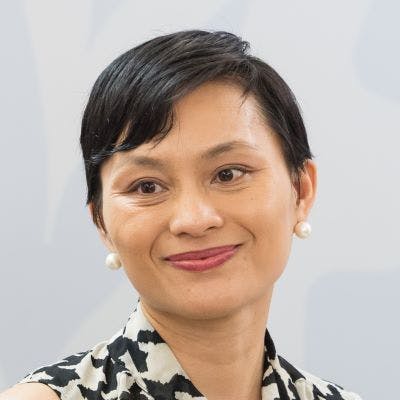
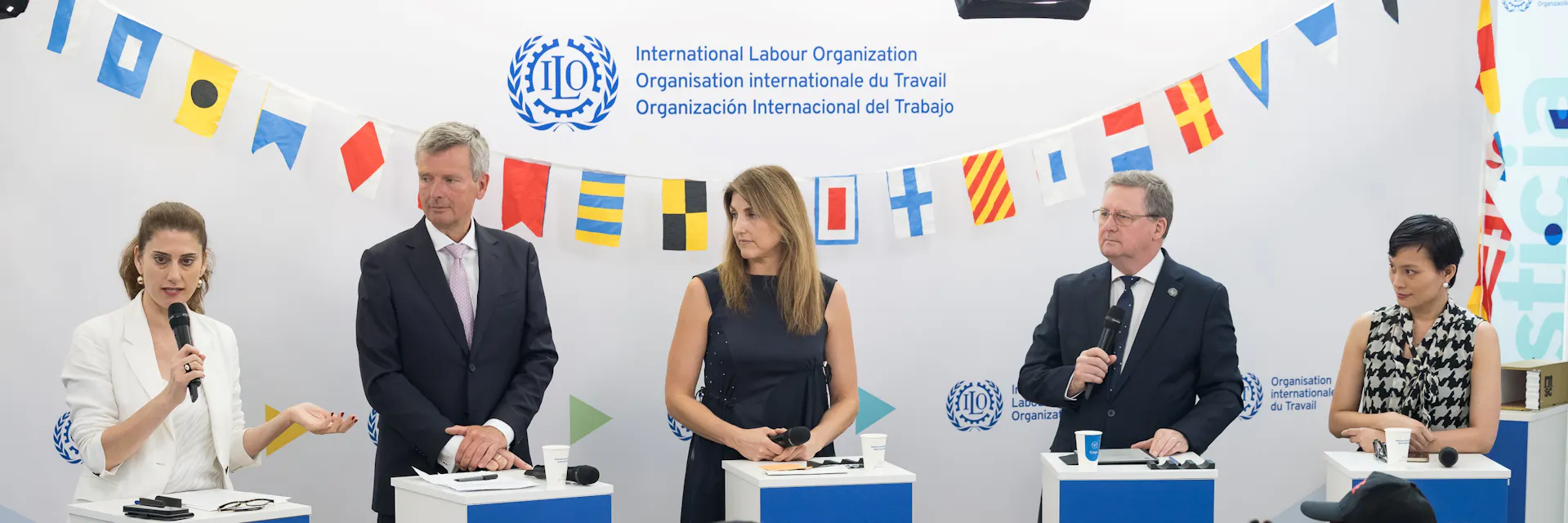
is what makes this particular Convention so different and special. And with us today to discuss this is a fantastic panel. I'll start from Lu over there. We've got Lu Camoying Valdez, who's the Head of the Human Rights Section at the Filipino Mission here at the UN and other international organizations. Mark Dickinson, who's come from London, especially to talk to us today and who's the Seafarers' spokesperson at the Special Tripartite Committee of the Maritime Labour Convention (MLC). Welcome, Beatriz Vacotto, our very own Head of Maritime unit here at the ILO.
And also a big welcome to Max Johns, who also came in to talk to us today, who's the former Shipowners' spokesperson at the Special Tripartite Committee of the MLC. A very warm welcome to our panel today. Beatrice, if I can start with you. What makes the MLC so special and what can it teach us about setting Conventions that impacts people in a positive way? Thank you Zeina. So the ILO has many innovative features. One is that it consolidate Conventions and Recommendations, more than 70 Conventions and Recommendations.
So you have in one book all the holistic protections of seafarers' rights. Another specific characteristics is that it contains binding and non-binding provisions. And these non-binding provisions are telling the government not only what to do, but how to do it. And they have proved very useful to support governments, inspectors, legislators, of course, seafarers and shipowners, but also the office. When we provide support and guidance to governments and when we have to tackle some serious violations
of seafarers' rights, for instance, when they are detained in foreign ports in connection with crimes without access to a fair process, here we have used these guidelines to defend them and to get them out of prison in many cases. But what I want to highlight today are two aspects that are key. One is the rapid amendment procedure, the simplified amendment procedure. I don't know if you know, Zeina, if we want to revise a Convention at the ILO, we need to adopt a new Convention. And so we start from all over again with a new Convention
ratifications, etc.. So the MLC has a process whereby when seafarers, shipowners and governments agree that there is a need to amend the Convention, they identify a new challenge, a new situation, they can agree on that, they can adopt it. And we have a period of three years from the moment of the proposal to the entry into force of the amendment. And let me give you an example. Even if we will discuss about this, take, think about internet, social connectivity. When the MLC was adopted in 2006, we already had internet,
but it was very expensive. It was difficult to have access to internet on board. Well, now it has become a common good that we all have access to. And last, in 2022, the MLC was amended to recognize this right to social connectivity to seafarers. And a final point I wanted to highlight is the issue that the MLC has a built-in enforcement mechanism it's one of the only Conventions at the ILO. So in addition to the ILO supervisory mechanisms that will review if the Convention is implemented or not, this Convention has a system of inspection and certification of ships,
and a dedicated system of onboard and onshore complaints for seafarers. And when the shipowner gets an MLC certificate, it has a benefit. It will benefit, it will be protected against delayed inspections in ports. And these inspectors in port may delay a ship, may detain a ship for instance if seafarers' wages are not paid. So this illustrates how this system helps the two objectives of the MLC: first of course to protect seafarers' rights, but second, and very importantly, to ensure a level playing field for shipowners and to protect,
I would say, Max, the good shipowners and the responsible shipowners. Thank you. Thank you. That's very interesting. And of course, none of this would have been possible without social dialogue. Can you tell us a little bit more about social dialogue, Mark? The role that it's played specifically in making sure that the MLC is so effective, it can be changed or amended quickly, and it can be implemented on the spot. Yes. Thank you, Zeina. And thank you, Beatriz for the the background to the MLC. Okay. Well, the cornerstone of the MLC is, of course, it's a tripartite
development that the instrument was developed through tripartism. But behind that to get us to that point we needed social dialogue. The industry, the seafarers represented by the seafarers' unions, the shipowners represented by their international organization, have very strong, a history of very strong social dialogue that's driven by the, the special nature of the shipping industry. It is inherently and perhaps was the first truly global industry.
The problems it faces are many and Beatriz has covered some of the more recent ones that continue to bedevil the industry. So solutions to global problems in a global industry need a global context. They need global standards. So we have an understanding across the social partners that there's a necessity for international minimum standards. Now why would that, why is our social dialogue so strong? I suspect and I haven't checked this with Max, but we have a worry
that governments left to their own devices might take decisions that might not be in the best interests of the industry. And of course, sustainability, although that's a word we use a lot today has always been an issue for a global industry sustaining its operations. It's so crucial to everything. You highlighted that 90% of everything comes and goes by sea. There's a genuine, general lack of understanding about what the shipping industry does and the maritime professionals, the seafarers that work within it. And without the ILO, without
the special provisions that we're able to - and mechanisms that we can facilitate in this house, the social dialogue. We have a unique body within the ILO that isn't so well known about: the Joint Maritime Commission. Now that's a bipartite structure. You don't hear so much about it these days. It has a residual role around seafarers' wages. But it was the engine. It was the driving force for the social partners to discuss what was needed in the industry, a level playing field and the ability to adjust
standards to meet a rapidly changing industry. And that is what drove social dialogue, that drove consensus around action necessary. And then, of course, we come to the ILO and we want to talk to governments. And that's where the unique and the very strong tripartite structure of the ILO was able to drive us forward on a consensus basis. And of course, achieving the consensus is such a big part of any dialogue of any Convention-setting process.
Let's take a real life example to illustrate to our audiences what we're talking about here. Maybe if I can turn to you, Max, looking for example, at the COVID-19 period. How did the MLC, what impact did it have on shipowners and seafarers in general and specifically during that really critical period where all were affected during COVID-19? Yes. Thank you Zeina. I think the most practical effect was that you still had something to dress and to clothe and to heat. Ships were still going during COVID, and that's what you all remarked.
Ships didn't stop. And I think to a large extent that was because of the MLC and the social dialogue. Very practically, seafarers would have had the right to leave the ships after a certain period of time. As shipowners, we had great difficulties getting new seafarers on board. So logically ships would have stopped. And here comes the dialogue. The seafarers came to us, or we came to the seafarers.
Then who was first? And we said, well, this is a global pandemic, so we have to do something about it. We have seafarers who are trapped on their ships. We have also seafarers who are trapped at home who can't go to work, and we have to bring this together. And so we talked about it. We found out it made actually sense to continue working, to continue shipping goods and the roof under which - it was a virtual roof at the time - was actually the ILO.
So the ILO facilitated these talks and made it possible. And without the previous years and years and years of social dialogue, it would not have happened. And I can assure you, and Mark said very diplomatically, that we have a long history of social dialogue. Before that, we had decades of fights. Seafarers and shipowners since the 1850s at least, were in continuous fight. And so I think the industry and the seafarers discovered
that doesn't make very much sense. And overall and from the industry side, we want to be profitable, we want to ship goods, we want to make money by the end of the day. And we can only do that when seafarers are actually working on the vessels. And so over the last, say, 40, 50 years, this slowly developed there was a Convention 147 and others and slowly we built trust. And building trust takes not weeks or months, but many, many years.
And that's culminated in COVID-19 when from one day to the other, we had to cooperate under circumstances we had never foreseen. And because we trusted the unions, and I think I can say the unions and the seafarers trusted us, that we did our best to liberate them, we finally got to a solution. And I think that's a good illustration for what that means. And what did you get to a solution for? What was the situation? What were you able to solve as a result
during COVID-19? We solved a lot of very practical, hands-on problems seafarer by seafarer. There was one thing where especially the ILO worked phenomenally. Lots of seafarers couldn't get home for up to two years. Other seafarers had to stay longer on board. Sometimes we actually had to break the rules. And you can only break the rules if you agree on that. Unilaterally breaking, unilaterally breaking the rules doesn't make any sense because then you lose trust. But here we could. The social dialogue enabled us to talk about it. Together,
we could go, together with the ILO, we could go to the governments and say, this is what we want. Please make an informed decision on vaccinations, on repatriation, lots of other things which are utterly important for seafarers. But here you also see the role of social dialogue is not only to be nice to each other within the industry. We also have to inform governments. So governments, politicians, diplomats have to make informed decisions
And they can't be experts in shipping. You can't be experts in all industries. So our role in the social dialogue is to give the information, say what we agreed upon, so that then politicians can make the proper decisions. And here in the COVID-19, sometimes after many months, they eventually did. Yeah. Right, thank you very much. I mean, you've just, brought up a really important issue, which is, you know, the fact that in some cases some seafarers were away from their families for two years.
This is part of a wider reality whereby seafarers can be at times denied health care, denied the right to get off ashore, may sail for a long time without seeing their families, may face criminalization and the risk of being abandoned. So these are all, or potentially even sail through conflict zones, wars, piracy, you name it. So these are all pretty, pretty significant. In fact, the need to protect them from danger and risk is so important
that the UN Human Rights Council adopted a resolution last year promoting and protecting the enjoyment of human rights by seafarers. And the Philippines was the country that sponsored this. And I'm very pleased to have Lu with us today, who played a key role in the whole process. Lu, can you tell us a little bit more why this was so important for the Philippines and what happened? Thank you Zeina. So about a quarter of the world's seafarers are Filipinos. Protecting and promoting their rights and welfare is a societal value for our people
and therefore a strategic imperative for our government. So during the COVID-19 pandemic, our government moved literally heaven and earth to bring thousands of Filipinos who were stranded in their ships, who had to go back home and, you know, fulfill their, who have already fulfilled their contract. So the MLC for the Philippines is an important normative framework and a protective tool for seafarers' rights. In fact, many of the key provisions of the MLC are incorporated in our domestic law,
the Magna Carta of Filipino Seafarers, which was adopted in 2024. But of course, we know that the MLC is a product of its time, a product of painstaking negotiations and compromise among different stakeholders who may be united on many issues, but ultimately may have different bottom lines, which means to say that there's always a room for improvement in terms of substantive coverage of the MLC and implementation, especially in a world of crisis and change
whose shock waves actually almost always impact a very strategic industry like the shipping industry and its seafarers. So this is why in 2024, the Philippines initiated the first ever Human Rights Council resolution on the Promotion and Protection of the Enjoyment of Human Rights by Seafarers, which was adopted by consensus by the Council and co-sponsored by 40 countries, mostly the major stakeholders in the shipping industry. So what does this mean? The Human Rights Council resolution, which we initiated, is really our response
to the challenges we faced as a government, as the stories of majority of seafarers, during the COVID-19 pandemic, and more recently to crisis situations that put our seafarers in harm's way. If we recall, during the COVID-19 pandemic while many of us were, you know, ensconced in the safety of our homes watching Netflix and baking cookies and cakes, many thousand seafarers were like, abandoned in ships or still serving
way after their contract has expired, without access to vaccines, medicine and no contact to families. So this had severe impact on the enjoyment of human rights, particularly the right to health, including the enjoyment of mental health. And of course, we can talk of the normal crises, I mean, challenges that they face in normal situations like, unpaid wages, long working hours. So the goal of the resolution was really to put a spotlight on the situation
of seafarers during crisis and even during normal times. The resolution recognizes that upholding safe, decent working living conditions at sea is a human rights imperative. And the resolution recognizes the MLC as a fundamental normative framework for advancing the human rights of seafarers, as well as it also encourages, urges stakeholders to strengthen collaboration for the more effective implementation of the MLC.
So among the key specific provisions that the resolution has is that it draws attention on the need to designate seafarers as essential workers. And it also encourages stakeholders in the industry to advance gender equality and inclusivity in a traditionally male-dominated industry. And finally, we are also looking into the encouragement for sea, shipping businesses and
the whole, the industries, the businesses that benefit from shipping to uphold their corporate responsibility, to respect human rights. And as a follow up, the Philippines will organize an international conference on seafarers' safety, well-being and human rights in September 1 to 3 in Manila. You're all, of course, invited. And one of the main topics for discussion is the
implementation gaps of the MLC, especially in the context of crisis situations, including unlawful attacks against the safety of maritime navigation, natural disasters, and of course, in the context of just transition as the shipping industry decarbonizes and shifts to newer technology, new, I mean, fuels. So, for the Philippines, the MLC is a living document that will always guide
stakeholders' collective efforts to give due - seafarers their due in terms of rights and dignity. Excellent. Thank you. And congratulations to the Philippines on this. But as you've rightfully said and pointed out that it is a work in progress, it's not perfect. And I'd like to come back to the ILC conference here in Geneva, because last week, the conference approved a number of amendments to the code of the MLC with an overwhelming majority, including some really important ones. I'd like to ask, maybe
we can start with Mark, but really very briefly in like literally the two main reasons why it's so important the changes that have been made, the amendments to the right to shore, to shore leave, fair treatment, very briefly. Okay. Well, just let me highlight a couple of the outcomes that I find particularly important. Given that we've been talking about COVID-19, shore leave was a big issue, that seafarers were denied shore leave. Lu has mentioned that, Beatriz has mentioned that, Max also too.
So we moved an amendment to regulation 2.4, which we, our expectation is that that will improve adherence to the provisions in the MLC, to guarantee shore leave for seafarers. I mean, they need it for their own well-being, to get a break, to go ashore, have a rest. But importantly, and this was revealed during COVID, access to medical and emergency dental care, that's really, really, really important. And the second one I'd like to mention, I think
Beatriz again mentioned or Max mentioned: criminalization. My union that I represent was created in 1857 for two reasons, but one of the reasons was criminalization. So all those years ago, seafarers are still being criminalized today. Now, as an industry under the auspices of the ILO and the IMO, the International Maritime Organization, we've adopted now two sets of guidelines for governments as to how to treat seafarers in two scenarios: in a scenario of a maritime accident and in the scenario of alleged crimes that they may have committed.
And those guidelines set out the fundamental rights of the seafarers to protect access to a fair process, to fair treatment. Both those guidelines are now mentioned in the mandatory par in code A of the Maritime Labour Convention, which means that Member States will be required to take those guidelines into due account. So another step forward towards advancing fair treatment for seafarers, really important in today's industry. Indeed, thank you very much. And Max, violence and harassment, also briefly please.
Yes, I'll try that very briefly. A very important issue indeed. We have dealt with the issue for quite a number of years, but we felt it's the time to enhance, and I think the ILO did also very important work here. There's a Convention for ILO aficionados, C190, which deals with the issue, and we had to implement, we wanted to implement that into the MLC. What does it mean? We have a very specific work environment. Seafarers work on vessels, sometimes weeks or months away from shore, away from families. So it's a very peculiar environment.
We all live and work together and bullying and harassment can very easily filter in and it's very difficult to filter it out. And so what we agreed upon here is that it needs a lot more, it needs to become a central part of the basic education for seafarers. So it's addressing the attitude. What does it mean that you have other people there, different people of different nations, different sexes, different orientations? And then also the concrete acts.
Some of the acts are of course illegal, others are - some people don't know exactly where they stand - and we had to take a firm stand here. This has to be outlawed. And again, so that's a special environment to work. The other environment is also very special: 2% are only women. So we always want to increase the work, the women, the female part of the workforce. But if bullying and harassment still exists, or if there's a rife environment for that, women will enter the workforce, maybe briefly, but they will leave very quickly.
And that's what we currently do see. Women leave the workforce much faster than men, and we hope these amendments will now lead to that. Now, just a short last sentence to the rapid amendment. So this was a very good example where we couldn't wait for ten years or so. An IMO, an amendment of the Convention would take 10 to 15 years. No, we agreed here, the industry agreed, the ILO was there, governments agreed. So we wanted to do something. Why wait for 10 or 15 years when we can agree
in two years, maximum three years? So this is coming quickly and there's a good reason it comes quickly, and thanks to this procedure, it comes quickly. Unfortunately, this is all the time we have for today. We could have gone on for another ten minutes at least. Thank you so much for listening and for being with us. And thank you to our great panel today, and we hope that you will be joining us for more conversations on the world of work. Now, don't forget to follow us on social media. You can find us on X: "@ILO", as well as Facebook: "@International Labour
Organization, LinkedIn: "International Labor Organization", Instagram: "@ILO_org" and YouTube: "ILOTV". Until next time, take care and goodbye from all of us here at the ILO.