-Hello, and welcome back to the ILO's Future of Work podcast. I'm Sophy Fisher. Sport is a global business, and there is no larger sporting event than the Olympic Games. Of course, the 2024 Games are being held this summer in Paris, France. The Olympics are much more than just a sporting festival. They're also a massive procurement, construction, and employment event. Since 1992, the ILO has been involved in the Olympics, introducing
the principles of decent work into the preparation and delivery process of the Games. The aim is to ensure that the Olympics don't leave just a sporting legacy. They also create a stronger, broader, and lasting social heritage, too. How do the Paris Games fit into this? With me today is Marie Barsacq. She is the Director of Impact and Legacy for the Organizing Committee for the Olympic and Paralympic Games in Paris 2024. That's Paris, France, of course. Marie, welcome to the Future of Work podcast.
Thank you so much for finding the time for us. -Thank you for invitation, and hello to everyone. -Right. Let me start. You are the Director of Impact and Legacy for the Games. What do you want the legacy of the Paris Games to be? -As you said, we have two objectives with those Olympics and Paralympic Games, to organize spectacular events for sports, to promote athletes and sports, but also to organize useful Games, Games which are more responsible
in terms of environmental issues and social issues. I am in charge of the second pillar. This objective needs to have concrete results even before the Games to convince the French population that those Games are useful and have a positive impact for our country. That's the reason why we work with all the stakeholders, and in particular, with the social partners to organize responsible in terms of social responsibility Games.
-As we were saying, there are major construction projects and a major opportunity for urban regeneration. What do you think the impact has been on Paris as a physical city and as a social city? -The objective with the Games is to answer the needs of the population. When we were bidding for Paris, we decided that the territory which needs housing, swimming pools is Saint-Denis, and not the city of Paris itself. The Mayor of Paris was totally agree with that.
The reason why, the only building we had were built in Saint-Denis in the region in north of Paris, very close to Paris, but the region which is the poorest and the youngest in France. The reason why we built two villages, one for the athletes, one for the media during the Games. Those villages were, first of all new, neighborhoods for the population there because there is a terrible need of housing in Saint-Denis. The only spot venue we built is an aquatic center.
Again, this aquatic center is built firstly to be a swimming pool for the community in Saint-Denis, in the [?]. For some international swimming competitions like the Games or the European Championships of Swimming in 2026, it's upgraded to welcome more spectators for those international events. Globally, every day is a swimming pool for the community. It has changed a lot the philosophy of the Games
because we really think, firstly, the needs of the population. -Now, another way in which these Olympics, I think, have broken new ground is with what I think is called the Paris 2024 Social Charter. This, I think, unites the Games Organizing Committee, the Olympic Works Delivery Company, the trade unions, and employer organizations. The idea is to deliver the Games so that they also include social benefits,
including decent work. Can you explain a little bit more about the Social Charter, the thinking behind it, and what it's aimed to achieve? -Yes, you're right. You have to understand why we signed this Social Charter. We really wanted to organize Games which are responsible and socially responsible. In order to do so, we need to work with the people in charge of this issue in our country. The social partners are the right person to deal with, to discuss with, and to work with. That's why we took 16 commitments with the 5 representative organizations
for employees in France at national level, and the 3 representatives on the employer side at national level in France. We signed this agreement in 2018. We took 16 commitments, very concrete, which commitments that engage our organization to do and to produce, to generate a positive social impact with the project. When you organize such an event, you have, for example,
€2.5 billion of call for tenders to launch. It is huge opportunities for SMEs, social businesses, and employment for your country. If you want to have this impact, you need to organize yourself. That's why we're seeing, for example, this Social Charter. -You mentioned SMEs there. Quite often when you have these big events, the budgets, as you say, are so large, that they can really only be bid for by very large companies.
Quite often, SMEs get cut out of these large projects because they simply don't have the capacity to bid for them in a way that's acceptable to the organizing committee. How have you done it so that SMEs, which are the grassroots of the local economy, can actually get a piece of the business? How have you done that? -We've done that with lots of anticipation. The first thing we did was to make a map about those call for tenders, in which areas we're going to buy things, what kind of things we're going to buy,
or services, when we're going to buy them. Those elements were essential to help those SMEs to organize themselves to be ready when we will launch those call for tenders. The second thing we've done was to make commitments with procurement strategy. Our procurement strategy asks five questions to every company that answers our call for tender. What do you do in terms of circular economy to reduce
your carbon print? What do you do to employ people with an impairment? What do you do to recruit people away from employment? Also, what do you do to generate a local impact? With this strategy, we encourage big companies also to work with small companies, SMEs existing at a local level to work together in order to answer this fifth question, what do you do to generate a local impact, for example.
The third thing we've done in that strategy for SMEs and social businesses was to create two platforms in order to help them to answer our call for tender and to help them to prepare themselves to do so. One was dedicated to the SMEs, it's called Entreprises 2024. The second one was dedicated to the social businesses, ESS 2024. Those two platforms published, of course, our call for tenders, but did lots more about it.
They also organize meetups. They also invited our director of Paris 2024 to explain our future call for tender, how are we going to select the winners of those call for tender? What are the key answers we are expecting? It has been very important overall to convince SMEs and social businesses that there is clearly real opportunities for them. It is not something written in a paper in a Social Charter.
It is something very concrete, and we were waiting for their answer. Today, before the Games, I can tell you that we have 90% of our companies that win our call for tender, which are French, 79%, which are SMEs, and 500 of them are social businesses. We have social businesses, for example, in very emblematic areas, like the cleaning of the clothes of the athletes at the village,
it will be done by employees which have disabilities or away from job seekers for a very long term. This is, for us, a way to showcase that it's possible to be SMEs or a social business to win a call for tender of Paris 2024. -That's a really interesting way that you've got the legacy down to the grassroots because it's obviously been a training exercise for your SMEs as well. -Oh, yes, of course. You're right. -That's SMEs. Now, one of the other things in the Social Charter,
and one that often comes up on huge projects like this, is the question of employment conditions. Now, you mentioned you've made a particular effort to incorporate persons with disabilities in the employment created by the Olympics. What about other things like illegal working practices, decent wages, decent working conditions, and so on? Have you managed to do anything with those as well? -Yes. We've also innovated in that aspect, especially on the different constructions area
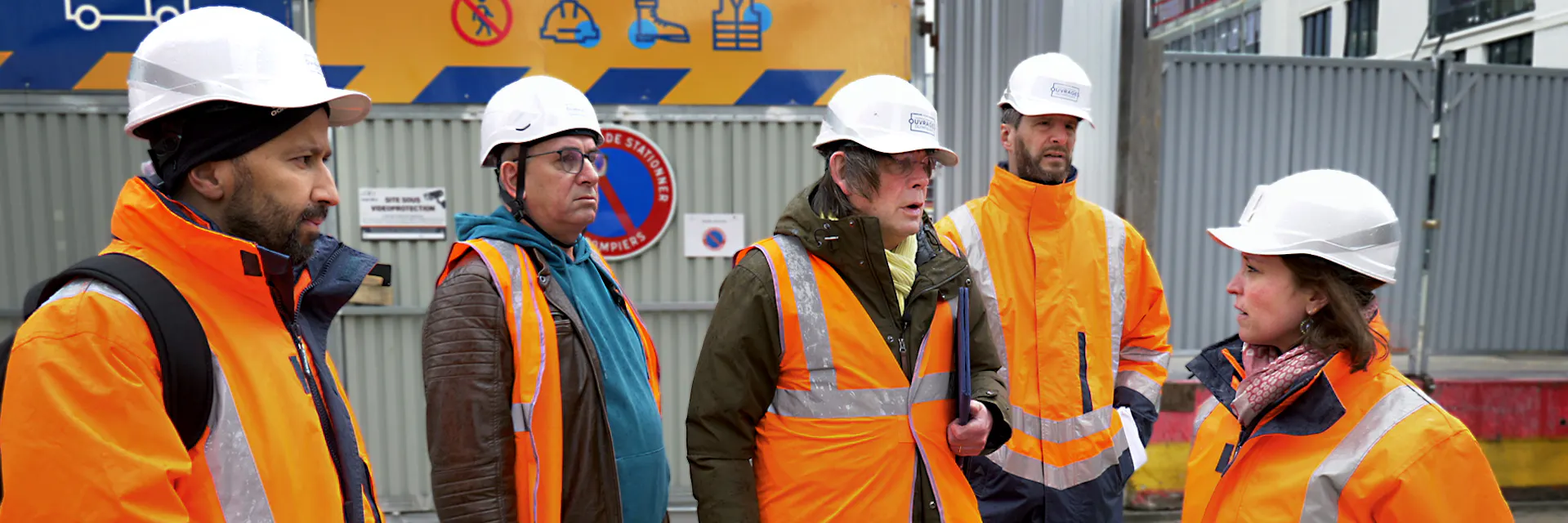
of the villages or in the aquatic center. We worked with a new company in France, which is called Bativigie, which is in charge of the regulation of the workers on those companies to be sure that they are regular workers. They have their files okay, and to combat illegal workers. It has been very helpful because it's a preventing action
that help us. We also work a lot with the Ministry of Labor. They help us to have lots of controls in all our workplaces to build the villages and the aquatic center, but also today in the sport venues, to also be sure that everyone working on these places were regular and they have the right to work there. It's, again, something very important that we demonstrate that if you invest
in this prevention area, you have some results. -How do you plan to ensure that these better employment practices, which you've managed to bring in for the Games, continue after 2024 because, of course, that's the essence of legacy? -We have results. If we took an example about working condition, on the building of the villages and the aquatic center, we have four times less accidents on those workplaces
than in average workplaces in France. Why? Because we made a lot of prevention and we have those controls. We demonstrate that with a strategy, with actions, you can reduce drastically accidents in workplaces. Today, we are promoting that and we are working with the government to explain that if you invest in that prevention area, you will have results, and it's something that can't be denied today.
-Right. Well, you are nearly at the Games. You've finished almost your preparation process. In a couple of months-time, the next Olympic host will be picking up the baton. What advice will you give to future Olympic organizers about integrating social improvements like this, perhaps into their Games as well and their preparations? -The first thing I will advise is be ambitious to commitments.
It is what we have done with the Social Charter. This Social Charter is clearly something very strategic. We took 16 commitments and we have to say what we have done with those commitments. Also, we have been ambitious with those commitments because we didn't follow the easy way. We wanted strong results. The second thing I should advise is to anticipate a lot. As I explained to you, we launched our procurement strategy very early in the project to be sure
that the 2.5 billion will integrate this strategy. We also mapped the different call for tenders, sectors, et cetera, to be very clear with SMEs and social businesses to give them the maximum information about that. We did the same with employment to be sure that the Games will benefit job seekers in the long term. Secondly, you need to secure money and people to work on those issues
because nothing is magic. It's a lot of work. You also need to convince your staff that you need people to work on those issues. -Ambition, anticipation, money, and staff, pretty crucial to everything. Well, listen, that's absolutely fascinating. That's so interesting to see that you have extended the mandate of the Olympics beyond simply athletic achievement into social achievement as well. That really is something for the history books.
Unfortunately, that's all we have time for this edition of the Future of Work podcast. Thank you very much, Marie Barsacq, for your time. -With pleasure. -Marie is director of Impact and Legacy for the Organizing Committee for the Olympic, and of course, the Paralympic Games in Paris. Thank you very much to you, too, our audience, for your time and your attention. I hope you'll join us again soon for another Future of Work podcast. Meanwhile, you can always catch up with us on social media. That's LinkedIn, X, and Instagram and sometimes on TikTok, too.
Until the next time, from me, Sophy Fisher, goodbye. [music]