[music] -Hello, everyone. Welcome to the ILO's Future of Work podcast. This is the latest in our mini-series, looking at youth employment, made by youth for youth. I'm your host, Maja Markus. Today's episode will focus on green jobs and youth employment. The climate crisis is undeniably one of the most pressing issues of our societies, if not the most. What are green jobs? Well, they are jobs that preserve or restore
the environment, and may replace jobs that are lost as societies transition to greener economies. Green jobs include jobs in clean and renewable energy, construction, sustainable agriculture, recycling, and waste management. They also have the potential to create 8.4 million jobs for young people by 2030. What can young people do to ensure a sustainable future for themselves? To discuss this, let me introduce you to our three guests of today.
Mette Grangaard Lund works at the International Labour Organization as a Junior Professional Officer in the Green Jobs unit. She works on the implementation of the Green Jobs for Youth Pact, an ambitious initiative of the ILO, UNICEF and UNEP, which aims to boost green jobs around the world. Our second guest is Boitumelo Molete. She works at a Congress of South African Trade Unions as a social development policy coordinator and has worked on the issues of climate change from a labour perspective for the past five years.
Finally, Rabiya Anwer. Rabiya is a young Assistant Secretary-General of the Employers' Federation of Pakistan with six years of experience in advocacy on decent work and the future of work with a focus on diversity and inclusivity in the workplace. Hi, Mette, Boitumelo, and Rabiya. It is really a pleasure to have you all here. -Hi. -Hi. -Let's jump right in. What do you think? How are young people who look for employment affected
by the climate crisis? -We can start with saying that today, more than 50% of the world's population are young people. They're below the age of 30, which I think is mind-blowing. They are also increasingly obviously engaged in the climate change agenda. We see that the strongest voices out there, they are the youth, and that's because they have everything to lose, but also everything to gain on this topic.
From an employment perspective, they are already quite marginalized from the get-go. After COVID, youth employment hasn't really bounced back. Today, young people are three times more likely to be unemployed than adults. Also, one in five young people, they are not in education, employment, or training. They are really coming from a position of disadvantage into the labour market.
Then, from a climate change perspective, it's quite interesting because young people are also amongst that group that has contributed the least to climate change. They can typically live in countries with relative lower emissions, such as India and Indonesia, and Nigeria that have very big youth generations as well, or young generations. They also live in countries or areas that are more climate-vulnerable areas.
They can be prone to global warming, or flooding, or droughts. They're both the ones on the receiving end of the catastrophe that climate change is, but they're also on the end of solutions and innovation and action. -Rabiya and Boitumelo, you actually have a lot of experience in this. What do you think, how as young people are affected the most by climate change, and especially when it comes to the work environment?
-Hello, I'd like to start first. This is Rabiya. Thank you for having me here. I agree with Mette actually that a search for employment has become even more difficult, especially in the transition towards green economy. In this global transition towards green economies, young people don't feel adequately prepared to participate in the green economy, which also leads to a lack of knowledge and skills. For example, in this transition, some jobs are being replaced, making it harder for young people to find employment,
and new jobs are being introduced. Due to a lack of knowledge and adequate skills, young people find it very difficult to secure employment, especially for young people living in the marginalized communities like in Pakistan, where they have limited access to technology, and some don't even have access to Internet. This further disproportionately affects their access to green jobs and green skills. -You, Boitumelo, you live in South Africa, and you have a lot of experience working there
with young people and also social partners. What have you seen? What are the main challenges? -What I've been seeing in South Africa is how young people have become so centralized into the discussions of climate change and just transition. It is young people that are coming forth with solutions with regards to how to actually form part of a bigger solution, whether it's from a policy perspective, or whether it's from implementation perspective. On the ground, young people are there to speak
to issues relating to how they could participate more in green economy, how their voices and their demands can be met by policymakers to ensure that there is policy that is sensitive to the fact that young people are the ones that bear the burden of climate change. They're the ones at the interface of unemployment, they're the ones at the interface of a changing world of work. Young people are the ones that are also going to be expected to participate
as employees or as business people in the low-carbon economy. Young people are there to ensure that it is their interests that are brought forward. Advocacy is quite a big thing in ensuring that the voices of the young people of various nations, including South Africa, are heard. -Yes, exactly. I'm actually really curious, because when I first think about climate change, I would not think necessarily about the world of work, about being employed, for example,
it's something that I have experienced and seen here at the ILO. How did this journey start for the two of you, Rabiya and Boitumelo? What motivated you to end up at this intersection of the environment and employment? -I can start, so I was introduced to the concept of green consumption as a lifestyle on social media. Even in local supermarkets, wherever you go and see them promoting purchase of goods that have a lower environmental impact, and then I found myself paying extra
for the paper bags, instead of plastic ones. From that very limited exposure to such a concept, then comes the pandemic. You've seen the headlines that in 2020 record in reduction of greenhouse emissions, which was due to the lockdown and widespread of restrictions on economic activities. By the end of 2020, as the lockdown was lifted, the emissions recovered to the previous year's level. This experience clearly demonstrated that restraining
economic activities did not slow down climate change. Actually, it resulted in painful consequences, and loss of jobs, rising poverty, and social injustice most important, particularly for poor urban households. This completely changed my narrative on the environment, which is a crucial topic directly affecting the health and well-being of everyone. Working in an employers' organization, I realized how employment and the role of employers become vital aspects of creating a more equitable
and sustainable future. This is how I started my journey, which is quite recent towards Employers' Alliance in Just Transition, which is a long-term campaign of commitment to engage with employers in the development of green jobs and investment in green practices. With this commitment, we are prioritizing, creating a balance for employers and academic institutions on the creation of green jobs and green skills and advocating for climate justice, especially in the marginalized communities.
-It's quite interesting how it happened. I was introduced to the trade union movement about six, five years ago. At that stage, it was when the work of climate change was gaining traction. At the time, it was in 2011 and COSATU adopted its first climate change policy. I was at the beginning phase of the work education with regards to enlightening workers on climate change issues. I started there.
The more I went into the field and speaking to workers and hearing the challenges that workers faced, and putting together what climate change meant for workers at the workplace, what climate change meant for workers in their communities, I got into the advocacy work of it, and speaking to climate justice. That was how I got introduced to the discussion and I literally fell in love with how workers were the ones that are giving solutions to how it is
we can combat impacts of climate change especially, with regards to the issues that workers were raising, on how climate change was affecting them on a worker-level basis. -Yes, exactly, because at the end of the day, we all have to work. We live in a system where we have to pay our rent, pay our food, and it's important to work in places that are sustainable and potentially green jobs are an answer to this and a solution. Mette, you want to say something? -No, it's just I think you're right, Maya,
that the social dimension of climate change or the jobs dimension is the final blind spot of how we talk and address climate change. Let's take, for example, circular economy for a second here. The ILO data shows that if we transition to a circular economy, we'll create some 78 million jobs, but 71 million jobs will be lost. That's an insane shift in the labour market, and that transition is not going to just be smooth from the last day
of March, and then you just start in your new circular job on the 1st of April. That transition is not going to just happen automatically. If we don't have the jobs dimension into this way that we respond to climate change, then we risk creating new challenges in a greener circular economy, but that is more socially unjust. -We have talked so much about green jobs and you are actually working in the green jobs units, so can you just briefly explain to our listeners how they can envision what green jobs are in the future
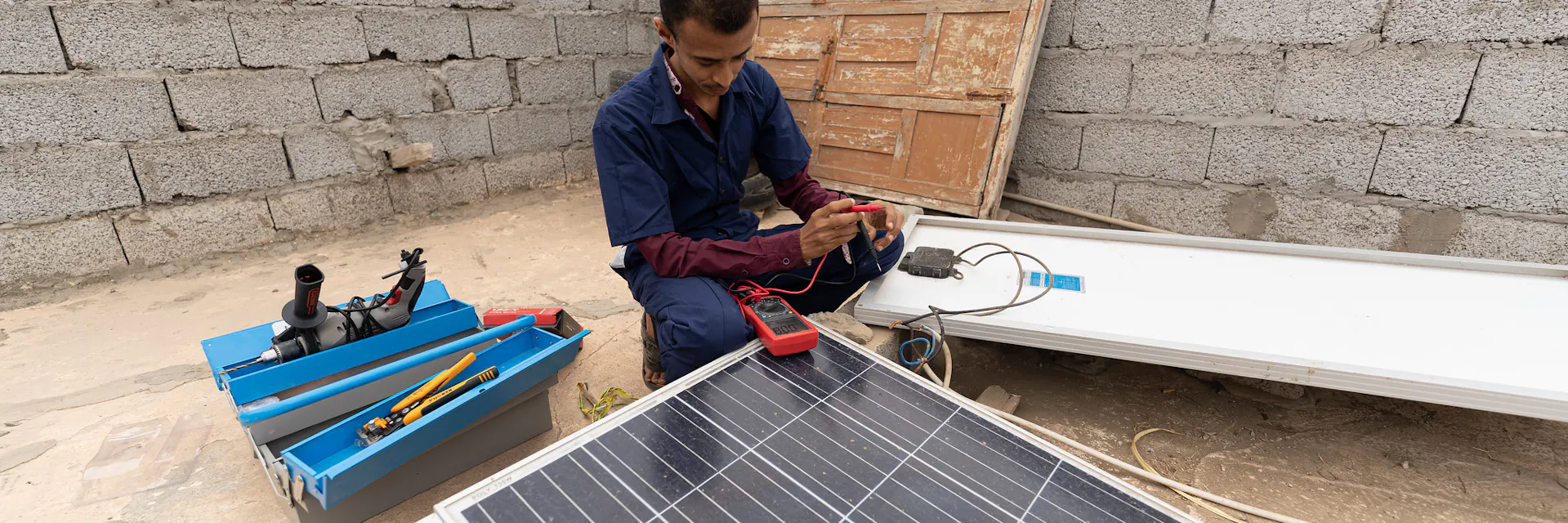
and especially for young people? -Sure. In the ILO, we work with this internationally agreed-upon definition of green jobs, where you look on a output basis. You can both be in a green job that produces a product or a service that is green. Those are typically the jobs that people think of. When they think of a green job, it will be a job that produces a solar panel, for example, but it can also be a job that greens a process.
Those are perhaps the jobs that are overlooked. That could be your supply chain manager that then suddenly has metrics on greenhouse gas emissions, or it could be your energy efficiency or water reduction, personnel, things like that. You can look at it as an output perspective, and then from a social-justice perspective.
Then it's really important to keep in mind that all these green jobs in the future, they're not necessarily these really high paying jobs with a hard hat going to a windmill farm somewhere with really good working conditions. Another argument is that, well, if you have a job that pollutes or emits a lot of greenhouse gases or contributes to global warming and makes someone else's livelihoods or life or health worse,
can you then argue then that is a decent job? No. That's why in the ILO, it's very important for us that the green jobs that we promote in the future will also be what we call decent jobs. -Exactly. For young people specifically, Rabiya and Boitumelo, what have you seen, what are the challenges to getting into these green jobs? What can we do to access these green jobs? Do you have any solutions or the main challenges that you have seen? -We most urgently need to address the challenges for young people who are
just entering the labour market, and they feel that they are unprepared for the jobs in the green economy. This directs us to take urgent action and equip the young people with skills and knowledge and provide economic opportunities to accelerate the work on a just transition or on a sustainable future. This will not only protect the environment, but will also advance the work on decent jobs and gender equality, but also the creation of million of jobs. Employers and academic institutions have a very important role to invest
in the training and education of young people to create opportunities for them when we talk about this shift towards a green economy. -You, Boitumelo, what do you think? -Sure. I couldn't agree more in that when we speak about green jobs, the most important part of it is to speak to how these green jobs need to be decent jobs. It's quite important that, that is factored in because we all know that shifting from this highly intensive economy means
that there is likelihood that workers would be taken into jobs that are less paying and jobs that are less of what they're accustomed to. It's important that we ensure that there's sufficient comprehensive protection for workers, especially social protection. These are parts that we also emphasize on in that green jobs need to ensure that workers' rights are protected and workers' rights are advocated for.
I think the biggest challenge when it comes to the participation of young people in a green economy at this stage is not having sufficient skills to form parts of this low-carbon economy, not having the sufficient education and training that is invested in for young people to be able to participate meaningfully in this low-carbon economy. I also think that the issue of job scarcity especially in the context of South African high unemployment, that also becomes a huge factor in that young people are already scavenging for jobs
in this current economy. -If I can just add in, I actually agree with Mette and what Boitumelo also said, is that the decent jobs and social justice, is that we often overlook that social justice cannot progress in an unequal and unjust world. The effects of climate change are felt differently by different communities, and often most by the vulnerable and marginalized populations. They're the most that are hit hardest. For example, in a society where--
for example, let's take a very urban place in Pakistan where certain groups have unequal access to education, healthcare, and employment opportunities, it is extremely difficult to do policy work and programmes that promote climate justice without first addressing these structural barriers. I think this is an evidence that this is the most important aspect that we need to look at, and that is climate injustice. -Thank you, Rabiya. Well, it's actually really interesting that you brought in lots
of different aspects from employers, workers, and I'm actually wondering what is done on the global level as well. For example, back in November, Mette you've been at COP 27, and you presented and launched the Green Jobs for Youth Pact, which is this new pact hosted by the ILO, UNICEF, and UNEP. Can you please tell us what this pact is really about, and why is it so different from other initiatives?
-Thanks, Maya. Yes, we did. The reason what brought the three agencies together around this pact was that we wanted to address this climate change and youth employment gap in a holistic manner. We wanted to do it in a meaningful way and an impactful way together with and for youth. That means that actually both, Rabiya and Boitumelo, are members of what we call the Youth Advisory Group of this initiative, where we are bringing young people into the centre of the way
that we are developing this programme or this pact as we call it. The Green Jobs for Youth Pact is aiming at, we have these what we think is very ambitious global goals of creating one million green new jobs for young people, but also greening one million existing jobs, which is really important in terms of what I talked about with these green jobs of greening processes, greening SME's, greening businesses,
but also the skills dimension that both Rabiya and Boitumelo talked about. The upskilling, reskilling of employees and young people. Then, the last element is also linked to what Boitumelo was talking about, where the job scarcity. That is the ambition of supporting 10,000 young green entrepreneurs. Of course, entrepreneurship can also be a way both to support self-employment, but also job creation for others. As was very clear from this conversation today
that climate action has to be complex and also holistic. That's why we have these three green E's, we call them, so green employment on entrepreneurship is the first one. The second one is education and skills for green jobs. The last one is youth empowerment and engagement. We really believe by bringing these three E's together, the agencies, the youth, the broader community of social partners of private sector, of education
institutions, building on existing knowledge that we have in the UN on our existing programmes, that we can work as an aggregator and accelerator towards these overarching goals. If we can jointly accelerate the creation of one million green jobs, then I think we can be quite happy with ourselves and proud of that joint effort. -No, that is very encouraging to see. On a more personal level, Rabiya and Boitumelo,
do you have any tips, for example, for other young people? What can we do on our own without relying on other organizations? -I'll let Boitumelo take first. Yes. -I think the best thing we can do as young people is be in solidarity with each other, regardless of where in the world we are, we're faced with the same challenges. It's going to be important that we form our own solidarity, even if it's outside of the formal organizations. However, it's important to note that the organizations that we represent are quite important to ensuring
that our voices are heard and are put on a larger scale. For example, us being at COP 27 is quite a big thing to have such a huge youth-led delegation across all sides of life, whether it be trade unions or employers. It's important that we collaborate. It's also important that we're able to articulate ourselves quite efficiently and effectively. It's going to be important that we invest in educating ourselves, capacitating ourselves, and speaking as loud as we can
across platforms on how it is that we want this Just Transition to be and how we want these green jobs to actually accommodate us as young people. It is our future and it is us that are supposed to be channeling and molding this transition into a manner in which it will best benefit us in the long run. -I actually agree with Boitumelo. I think she said it all. The keywords being solidarity and collaborate.
Historically, if you see that young people have led the change against social and economic injustice. If we go past several, a few years back, young people are also mobilizing in large numbers. A perfect example of that is Greta Thunberg, where she has inspired and continues to inspire young people, including children globally, to take urgent action on climate change. That's just not on climate change, we can collaborate on many other socioeconomic issues as well.
This shows that young people are not only victims but also valuable contributors and agents to climate action. I say that we have to move and take action to create a better and more sustainable future for ourselves. With the advent of digitalization and social media, many young activists have taken these platforms to speak up and engage globally with young people in creating awareness and increasing the knowledge and capacities of young people who have not yet engaged with the issue.
That's how I got introduced to this topic. This is a perfect pathway, I guess, for the youth, with the youth by the youth. -Well, thank you so much for all of your comments. I think I'm feeling even more inspired now. I'm sure that our listeners really appreciated this discussion. I'm looking forward to hearing even more also about your work, about your future, and the Green Jobs for Youth Pact. That concludes this episode on youth employment and green jobs. Thank you again for joining me, Mette, Rabiya, and Boitumelo.
Thank you for our listeners for listening and joining the Future of Work podcasts. Don't forget to tune in for our next episode. [music].