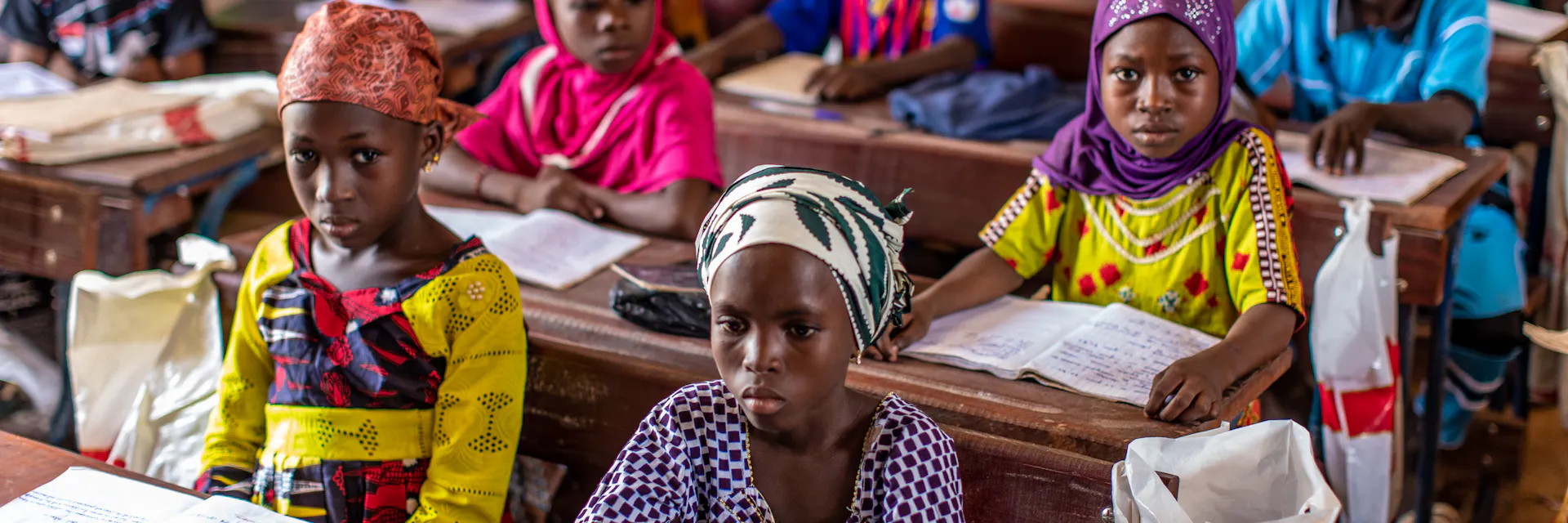
Good afternoon and welcome to our ILC lunchtime conversation coming to you from the International Labour Conference here at the Palais des Nations in Geneva. Every year on 12th of June we mark World Day Against Child Labour. We know the figures: 138 million children are still in child labour, 54 million in hazardous work. Last year, in 2025, the world missed the 2025 SDG, the Sustainable Development Goal target of ending child labour.
But here's what's different about today. Four months ago, in February 2026, governments, workers, employers and civil society gathered in Marrakech, Morocco, to adopt a Global Framework for Action Against Child Labour. They made a firm commitment: ending child labour must stay a global priority through 2030 and beyond. Now, how do we get there? Do we need a new set of ambitious targets?
What kind of concrete milestones can we put in place while bringing on board regional specificities? That's the focus of our dialogue here for the next 25 minutes. And to guide this conversation, I'm very pleased to welcome Jacqueline Mugo, President of the International Organisation of Employers, IOE. Welcome. Cyrene Martinsson Waern, Workers' delegate, Sweden. Welcome. And Federico Blanco,
the ILO Head of the Research and Evaluation Unit in the FUNDAMENTALS department. Welcome, all four of you. So here's how it works. We have two quick rounds of questions, no long answers, specific but real concrete examples, and then we close with some key takeaways. First round of questions. Why must child labour stay on a post-2030 agenda? Let me start with the key question that brings us here today. I mentioned earlier that the world just missed
the 2025 elimination of child labour target. So why should we put child labour back on the post-2030 agenda as a distinct measurable goal instead of absorbing it into broader poverty or education targets? Why does it need its own spotlight? So before our panellists start, Federico, maybe you can take us back to Marrakech and the framework, which calls for an ambitious zero by 2040 target, or does it advocate actually for
reduction targets with intermediary milestones? Hello colleagues. Thank you for having me here. The framework in itself doesn't call for a specific target. It just recognizes that ending child labour must remain an absolute priority throughout 2030 and beyond. Setting a target is something that will be dealt with also in the framework that will
replace the Sustainable Development Goals, and the discussions for that will start next year. When it comes to child labour, we have lots of progress that has been achieved in the last 25 years. We started the year 2000 with 245 million children in child labour. We are today at 138 million children in child labour. The target, SDG target 8.7, was to reduce it to zero. This deadline has passed. The target was not met.
But the commitment does not expire with the deadline. It is very important, and that's the key message that we're sending, that whatever replaces the SDGs needs to have and to factor child labour within it. And with child labour we are in an advantageous situation. We have seven global estimates and regional estimates of child labour that the ILO has produced and UNICEF, the latest one. We have regional trends.
We know where we're going. And this measurement also influences our capacity to take action on the problem. We cannot end what we cannot measure. So that's my first reaction to your question. Very good. Okay, so now we just got the ILO expertise. Thank you for sharing that. Let's go to lived experiences, and I'm going to start with you, Cyrene Waern. From the workers' perspective, why must child labour stay on the global agenda after 2030?
What changes for workers if child labour becomes invisible in the post-2030 framework? Thank you so much for the question, and thank you for inviting me here and for inviting workers on this very important topic. Well, the failure to meet SDG 8.7 was not a failure of ambition. It was a failure of political will, enforcement and financing. Workers' organizations refuse to accept that the response to missing a target is to lower the bar.
As we have said here, 138 million children still in labour. That could never be acceptable. So progress is 11 times too slow. These are not statistics, not mere statistics. These are children, children that should be in school, but instead they work in agriculture, in mining, in construction and domestic service, while their peers are in school. For the trade union movement, every one of those children represents a family without a living
wage, a labour inspector who never came, a supply chain that was never audited, and a government that signed commitments but did not fund them. So it needs to stay a target and a goal of its own to make governments accountable and to make funding a reality and take action. Thank you. So we had the workers' view. Let's see what now the employers are thinking. Why should employers support a dedicated post-2030
target on child labour instead of saying, well, we'll just comply with the kind of regulation that already exists? Thank you very much for that question. It's a privilege for employers to take part in this important conversation. I think we've been given the numbers: 138 million children still working in child labour. So from the employers' perspective, one of the most relevant elements of the Marrakech Global Framework, which was passed in February this year, is its strong emphasis on moving from commitment
to action through practical implementation, particularly within enterprises and supply chains. The framework rightly recognizes that eliminating child labour requires addressing its root causes, including poverty, informality and lack of access to quality education, while at the same time strengthening responsible business conduct. For the International Organisation of Employers and its global network of more
than 150 employer member organizations, this dual approach is essential. Businesses are not only economic actors. They are also key partners in prevention of child labour. We see particular importance in the framework's focus on root causes of child labour, the ones I've mentioned: informality, poverty, limited access to education. But there's also the reality of lack of social protection floors, insufficient
labour inspection and weak governance. If we fail to address these root causes in a comprehensive manner, we will not succeed in our fight against child labour. Equally important is the recognition of SMEs, which form the backbone of many economies but often lack the tools and capacity to address child labour. Supporting these enterprises is therefore critical if you want real impact on the ground. In short, the framework reflects a priority that is central to our work as employers,
and that is embedding child labour prevention into our systems and the work that we do so that we can tackle the root causes while also working in partnership to address underlying vulnerabilities. Because employers recognize that we cannot do it alone, but we have a very important role to play. Okay. So what I'm hearing from social partners here, and even the ILO, is that child labour can be diluted if it gets absorbed into broader goals. It becomes invisible, and invisible means unaccountable.
Okay. But how do we now target that? And on one side, we have zero child labour by 2040 as a suggestion, as a proposal. On the other side, you have cut child labour by 50% by 2035 with regular reporting. That seems enforceable, that countries can actually be held to. But let me go back to the ILO expertise again. Federico, if we set a credible reduction target
like 50% by 2035, what would actually be needed in terms of making that achievable? Is it financial resources? Is it governance? Different kinds of governance? I think that this question deserves a lot of dialogue. Setting a target is not something that we can do lightly. We have to take into consideration ambition and reality, and to strike
a good target means finding the right balance between these two. In the case of reality, we know what reality is because we measure it. We have 138 million children in child labour, and we have been measuring this at the global level and at the regional level since 2000. So we know what has been the pace of progress and even, in the best possible scenario, what has been the best pace of progress.
Ambition is something that will emerge from the discussion of the replacement of the SDG framework, and perhaps an ambition would be to move faster than we have ever moved in the past. That to me is what ambition means. I think that I would not address your question because I think that this question is a question that should, the answer to this question
should emerge from social dialogue. It's not only a technical exercise. Having said this, I would like to raise a couple of considerations. The current target that we have is an absolute target. Some targets in the SDGs are relative – reduce by 50% by date X a certain issue. An absolute target has challenges and implications as well.
For example, we observe that the problem is concentrated. The problem of child labour is mostly concentrated in Africa. And there is also great progress in Africa because there was a reduction of the prevalence in Africa, even in the context of challenges, of all what we're witnessing, conflict. There was a reduction in the prevalence, but this did not translate into a reduction in the absolute numbers. The absolute numbers are estimated, and
they are estimated because of the demographics. There is population growth, especially in the target population of children, that makes targets in terms of absolute numbers very difficult to achieve. So I'm not saying what the target should be. I'm just saying that we have a strong scientific basis to look back. We need also to add ambition, and that needs to be the discussion from 2027 onwards. Thank you. That's a nice way
to address the question, actually. Thank you Federico. Okay. Now if we go to the second part, what should the next target look like? We had the expertise of the ILO. I'll go back to you, Cyrene Waern, from Workers Sweden. Which one would you push for, absolute zero by a fixed date or a credible reduction target with milestones, binding milestones? Well, we could never accept anything else than an absolute target, of course. Every child should go to school instead of
working, and especially not working in hazardous work. So for workers' organizations, we do support an absolute target: zero child labour, anchored to a specific date, combined with legally binding intermediate milestones that must be monitored, that must be enforced and resourced at national level. The zero by 2025 deadline has already slipped. We are realistic, but we should not replace
it with a target so hedged that it cannot be enforced. Our position: set the absolute goal, zero child labour, with a revised horizon of 2035 and require every government to adopt a binding national road map with five-year milestones, costed action plans and tripartite accountability mechanisms. We can't let the Marrakech agreement become a paper tiger, a paper agreement that is not enforced. Thank you. Jacqueline Mugo,
from the International Organisation of Employers, same question from your angle. What kind of target would you support and what would make it credible? I think we're all in agreement, and that is that we need hard targets and the ambition must be to eliminate child labour altogether. That was always the ambition from the beginning. But the reality on the ground has made it very difficult, especially in regions such as mine where the demographics tell a different story. But I believe if we are serious about
accelerating progress, because we must have incremental progress, we must now focus on scaling up concrete measurable actions. First, we need to strengthen the capacity of enterprises, especially SMEs through practical tools, training and guidance. Many businesses are actually willing to act, but they need accessible and realistic solutions that can be implemented within their operational realities. Second, we must scale up our collective action. In this regard, the Alliance 8.7 brings together UN
organizations, governments, social partners and civil society at both international and national levels. The Alliance has a tremendous convening power and is connecting the dots between the international and the national levels. It is this kind of innovation which is triggering collective action. Third, government plays a critical role, and I think it's unfortunate that we don't have a government representative here today because they help have effective policies.
They look into enforcement and investment in education and social protection systems. We know that education is really the key to getting children out of the difficulties we're talking about, and that it is essential to addressing the root causes that drive child labour. Fourth, we must do better at getting the data and the statistics. That is what the ILO is talking about. We simply need better data so that we monitor and we can have accountability mechanisms.
Without clear measurement, we cannot track progress or allocate resources effectively, and resources have been one of the key drawbacks. Finally, and most importantly, we must ensure that interventions are adapted to local contexts, particularly in informal and high-risk sectors that are prevalent in developing economies such as mine, where standard approaches may not work. So if we act collectively, and particularly in these areas, we can move from incremental
progress to reacceleration and eventually our dream of elimination. So if we hear correctly, let me try to synthesize what we've heard now. Three key insights. Obviously, child labour cannot disappear from the post-2030 agenda. The target must be credible, not just ambitious. And we need regional flexibility, recognizing different starting points, especially, as you
mentioned, Africa, Federico. So here's what it means. For the next six months, this is going to be very critical. Alliance 8.7, the ILO, UNICEF and Member States are in technical discussions right now about the post-2030 target and how it will be. So more than ever, obviously, the tripartite voices are needed. So thank you to all our panellists for this honest and challenging conversation. We hope you'll join us again for more
conversations on the issues shaping the world of work. Don't forget to follow us on the ILO social media platforms for regular updates and insights. We are on Twitter, X @ilo. Facebook: @InternationalLabourOrganization. We're on LinkedIn: International Labour Organization. Instagram: @ilo_org. YouTube: ILO TV. So until next time, take care from all of us at the ILO, and thank you. Thank you so much.