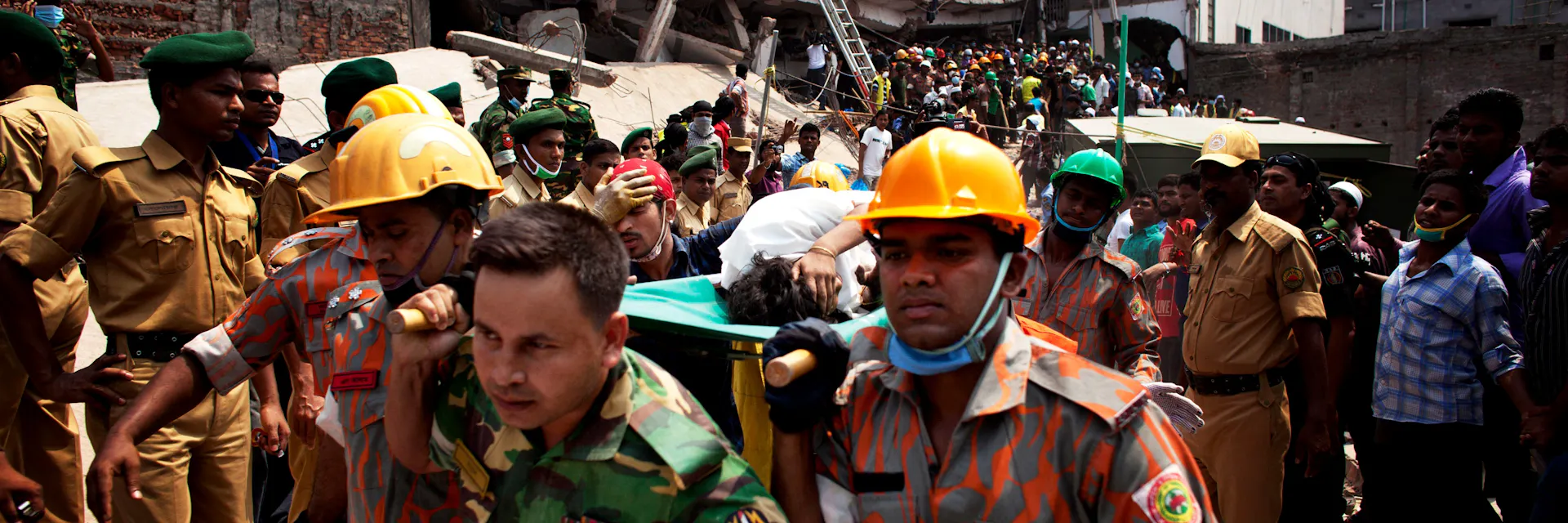
[music] Hello, and welcome to this edition of the ILO's Future of Work podcast. I'm Steve Needham at the ILO regional office for Asia and the Pacific in Bangkok. On the morning of 24th of April 2013, the nine-story Rana Plaza building in the outskirts of Dhaka, Bangladesh collapsed. Over 1,130 people, mostly garment workers, lost their lives. Many more were injured or faced a very uncertain future.
However, Rana Plaza was no local disaster. It raised fundamental questions worldwide on workplace safety, labour rights, and supply chain governance, and through the clothes in our wardrobes, it was a disaster we were all directly linked to. In 2013, the future for the Bangladesh garment industry and its 4 million workers looked very bleak indeed. 10 years on, what's changed? To talk about this, I'm joined today from Dhaka by Tuomo Poutiainen, the Director of ILO's country office in Bangladesh.
Tuomo, welcome to the Future of Work podcast. You've been in Bangladesh for a large part of the last decade. Is the garment sector today a safer place than it was 10 years ago? Thank you, Steve, and first of all, thank you for having me. Of course, the Rana Plaza 10 years ago was a tremendous shock to the industry, and I think it's fair to say that quite a lot of positive changes have happened since, particularly in relation to industrial safety and occupational safety.
What are the main differences now compared to 10 years ago? First of all, Rana Plaza resulted into a lot of reflection in relation to should there be industrial production amidst urban spaces and inside the city for Dhaka. What in the first and foremost happened is that there’s reorganization of the industry, and now you will find more and more and almost exclusively, the garment and textile industry being operated in industrial zones
and industrial districts, and not anymore inside the city. That’s one thing. The second thing is that it really resulted into quite a big effort to look into industrial safety and occupational safety in terms of particularly fire safety, structural issues of the buildings, and also electrical safety. That work has tremendously improved the general condition
of the facilities and factories where the production is done. Thirdly, at the same time, issues around workers’ rights and workers’ voice, why was it that the workers did not have the ability to leave the facility when it was trembling? Why was it that there is such a low trade union density and such reluctance to have trade unions?
That issue of trade unions and the issue of workers’ voice came also to sharp focus. There has been good progress over the past decade on improving workplace safety, and your progress on labour rights still appears to lag behind. What are the challenges there? What still needs to be done? I think, first of all, the laws are still lacking in terms of providing the type of labour rights that the ILO prescribes
for the international conventions. There is an amendment process going on where the government is looking into-- together with employers and workers, is looking into how to amend the labour laws so that there can be more modernized and more inclusive and better quality laws that will allow for trade unions to operate in the way that they should be allowed to operate. That’s one thing. The legal framework is being changed to accommodate
some of the current challenges. The second issue is the issue of registering trade unions and assisting the trade unions in terms of their own organization and their own processes so that they can also move into become more modern and accommodate not only the garment sector but also other emerging sectors so that the worker's voice needs to be organized and represented can increasingly be there
so that emerging sectors, for example, in Bangladesh such as IT service sectors like manufacturing sectors and so forth, that these workers also can have vehicles to express their interest and voice. Thirdly, it’s about the issues around having a seat in the table when things are negotiated. It’s about the employers and the government accepting that the trade unions need to be a negotiating partner, and it’s to help the trade unions
to prepare for such negotiations and to become a meaningful party to this what we call tripartite discussions and negotiations and bargainings around improvement of working conditions and general decent work in Bangladesh. At the time of Rana Plaza, it was clear the capacity of the Labour Inspectorate and other regulatory bodies simply failed to keep pace with the massive growth of the garment industry. How does that stand today? Indeed, there was a limited capacity at the time,
and the government very quickly recognized that and stepped in together with international organizations like ILO to really improve and modernize and start to build a completely different kind of labour inspection system. Not only a labour inspection system but also other enforcement agencies such as fire safety and civil defense who is, of course, responsible for safety issues as well.
Boiler safety agencies and other agencies who are responsible for keeping the workplaces safe, they all have been under positive reform processes in terms of human resources, in terms of tools, in terms of enforcement mandate, and in terms of their overall effectiveness. This enforcement and proper industrial safety governance has been a big focus It’s the general role of the government of this improvement process.
It’s the general role of the government. Government has to step in. Government needs to continue to improve and maintain its processes to keep workers safe, but also to influence and improve on the working conditions. At the end of the day, it is the government’s responsibility to enforce laws and standards, minimum standards, but it also has to be translated into these other industrial sectors that are growing, the local industries so that, generally,
the country continues to maintain, further develop, and provide the kind of both enforcement and also private sector incentives to retain industrial safety and occupational safety in Bangladesh. Tuomo, turning to the role of brands and retailers sourcing from Bangladesh, how has their approach changed over the past decade? There has, of course, been a lot of attention by the international brands and buyers, particularly in the garment industry.
That has been, typically, around compliance of individual brand to an individual supplier or a group of suppliers. That’s something that actually changed quite a lot after Rana Plaza. Now there was a collective need of the buying organization and brands to come together and to ensure that there is a more democratized and more broader improvement process going on in Bangladesh.
That’s really what happened, and in many ways, the private sector came together through organizations such as Alliance and Accord at the time, and now there is also some new news organizations such as Nirapon, and such as RMG Sustainability Council to act as a conduit and as a help organization to continue to pursue safety in Bangladesh and maintain safety in Bangladesh.
Quite a lot has changed. Basically, transforming individual compliance initiatives more to collective industrial safety initiatives, and I think that’s very positive and good. Just last year, a pilot employment injury insurance scheme for the garment industry was launched in Bangladesh. Why is this important? This is tremendously important, first of all, and it’s something which is extremely tangible in terms of modernizing and improving accident protection.
If there’s one thing that really resonates in terms of Rana Plaza, it’s the fact that when such accidents happen, there was not really a solid compensation scheme to make sure that those who were hurt or their families would be properly provided with care and properly compensated for a longer term. This employment injury scheme is really to, overall, over vamp and to improve
on the whole of the employment injury protection in Bangladesh. First covering the government sector and then potentially moving to other sectors. What is remarkable about it is that it is based on a loss of earnings principle. When you’re hurt, you don’t get just a compensation for one time and then nothing, but you get a compensation for a longer term depending on your employment prospects, and also,
depending on the nature of the accident and the disability. That really changes everything for those who are affected by accidents. The other thing that is remarkable about it, is that it’s nationally owned, nationally governed, and in an equal measure, the government, the employers, and the workers are part of governing the system, and so that’s also extremely important and positive.
Tuomo, what can other garment-producing countries learn from the Bangladesh experience? I think what they could possibly learn is that the improvement processes, first of all, they do take time. That’s one thing. One has to be very clear in terms of what kind of reforms one is working on and organizing, and that those reforms they need to be predicated on three very important things.
One of them is building better governance and enforcement capability and laws. The second is that the private sector and the employers have a tremendously important role to play because they are really closest to the workers and to the work. In order for the industries to remain competitive but also to provide the decent working conditions that workers and employers both deserve, they need to step up, and they need to establish the right management systems for human resource management,
safety management, quality management, environmental management, and so forth and for that exercise, not to cut corners but to actually increasingly work towards better standards, better competitiveness, and better sustainable business practices. The third area is the workers themselves and the workers’ voice. The enabling environment should be there for workers, unionized or not unionized, to be able to raise issues, to discuss, and to play their part in terms
of keeping workplaces safe and keeping Bangladesh productivity at work. Trade unions play a very important role in this but there’s also the general environment of workers being able to discuss, to raise, and to partner in realization of decent work. Those three things are extremely important going forward. 10 years on, what do you see as the legacy of Rana Plaza, and what will the next 10 years bring?
I believe that 10 years from now not only the garment industry, but many of the other export industries in Bangladesh have truly internalized some of these change processes and are also effectively applying them. There is increasing global pressure through due diligence, legislation, and responsible business practices to ensure that if you want to sell things, particularly to certain trading partners,
you need to continue to improve and apply good labour standards and also good sustainable environmental practices. I think the 10 years have really prepared, in many ways, Bangladesh and its industries to take advantage in a way of the improvements that have been made and prepare themselves for the next 10 years. In 10 years’ time, I hope to see a very modern and capable industrial sector that is socially compliant
and is predicated on sustainability in a competitive way. I also expect to see governance system and enforcement systems that are increasingly effective, increasingly results-oriented, and delivering protections and remedies for workers and employers alike. I expect to see a trade union movement that is extended and invigorated and covers not only the garment industry but also other industrial sectors and other service sectors
for the benefit of everybody. Tuomo, thank you very much for joining us today. It’s been great speaking with you. If you’d like to find out more about ILO’s work in the Bangladesh garment sector or more generally, you can find links on the web page of this podcast, which is on the ILO website. That’s all for now. Thank you for listening, and goodbye. [music]