[music] Hello, and welcome to another edition of the ILO's Future of Work podcast. I'm Sophy Fisher. It's likely that during our lives, almost all of us will need the services and skills of care workers. Yet, one thing that became clear during the COVID-19 pandemic is that this type of work is frequently undervalued, both in terms of status as well as pay and conditions. This is particularly the case for those who do care
work in the private homes of others often as part of a broader portfolio of home-based tasks. I'm talking, of course, about domestic workers. Some countries are now reevaluating the status and conditions of their care workers as part of the efforts to attract more workers to the sector and meet growing demand. However, there is a danger that those classified as domestic workers will not benefit from this process. June is the month in which we mark International Domestic Workers Day.
This celebrates the passing in 2011 of ILO Convention 189 on decent work for domestic workers. This was the first international labor standard that recognized domestic workers for what it is, which is real work. This is an appropriate moment to look at the role of domestic workers and how their contribution to the care economy can be recognized properly. With me today are Claire Hobden, who is ILO Technical Specialist on domestic workers and other vulnerable groups,
Mimi Jalmasco, a migrant domestic worker in the United Kingdom with the organization Voice of Domestic Workers, and Ai-jen Poo, who is president of the National Domestic Workers Alliance in the United States. Welcome to you all, and thank you very much for joining us on this podcast. Mimi, can I start with you? You are our migrant domestic worker on this podcast. Can you give us an idea of the range of tasks
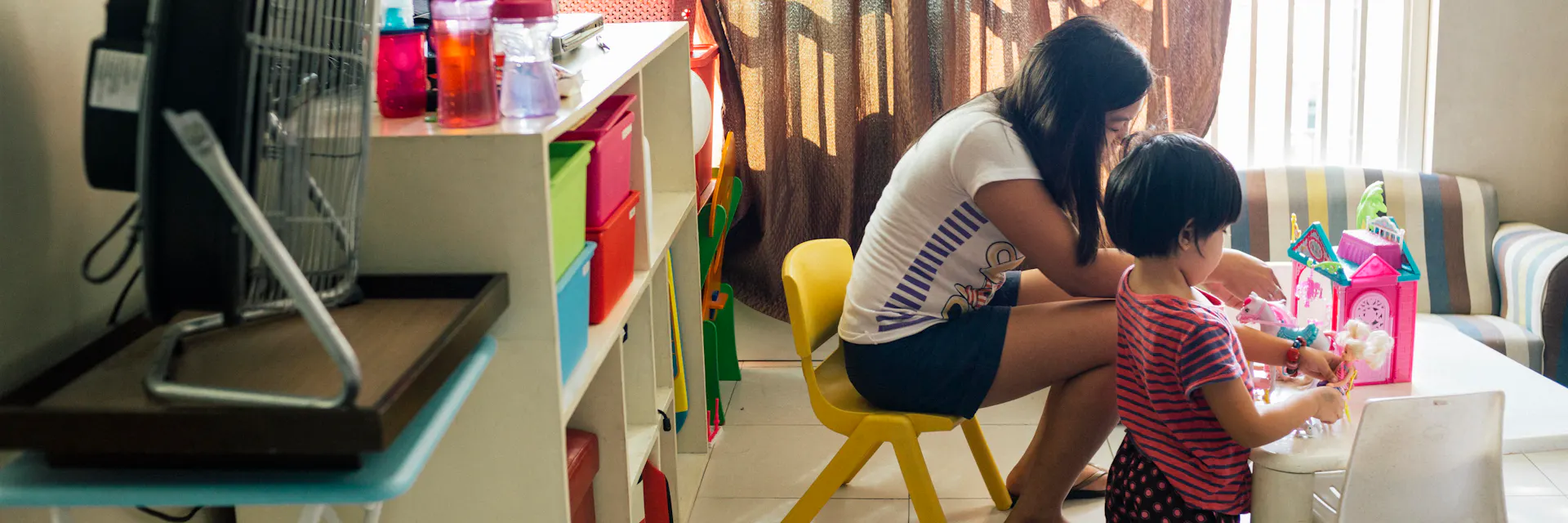
that you and your colleagues carry out and perhaps those that would qualify as care work? Yes. Domestic workers, we are multi-skilled workers. We are not only doing the cleaning or housekeeping, but we are also doing elderly care and child care as well. With me, I am a full-time nanny with a German family looking after two and a half-year-old girl.
Presumably, you also do a lot of cooking and cleaning tasks as well, which would be indirect support for care work. Yes. Most of us here in UK are all doing not only nannying job, not only elderly care but also aside from that, are also doing cooking, laundry, ironing, it's all-around, housekeeping as well, cleaning. Claire, do you think there is enough recognition of the fact
that not only are the core care, you might say the direct care services part of a domestic worker's work portfolio, but also these indirect tasks which, of course, really are part -of the care work portfolio? -Absolutely. I think that, in general, people have an understanding of domestic work as being "only cleaning or only taking care of the cooking", for example. The ILO has a definition of care work that includes
both direct and indirect care services. I think this became so abundantly clear during the COVID-19 pandemic, when the cleanliness of homes, and employers were very keen on ensuring that their households were free of the virus. That whole environment, I think, taking care of the environment was really key. That is a form of indirect care work in our book.
I think it's also really key in ensuring a healthy lifestyle. If you're going to be preparing food for a family, you want to make sure that that food is healthy. It's another form of provision of an indirect care service. Ai-jen, do you think that there is enough appreciation of how important care work is for the broader economy? It seems that it is often regarded as something that's nice to have but not particularly crucial, whereas a lot of people would say,
"Well, care work is freeing up other people to take part in the economy outside the home." Right. We call care jobs job enabling jobs because they're so fundamental to the economy. I think we really saw that underscored during the COVID-19 pandemic when in the United States alone in the two months, when the shutdown was begun in March and April of 2020,
4 million women were pushed out of the workforce because of caregiving challenges, because of their lack or loss of access to care work. It just goes to show how fundamental care jobs are to the functioning of the economy and to the topic of the future of work. These are jobs that are undeniably jobs that will be a huge share of the jobs of the future. These are jobs that can't be outsourced and won't be automated.
No matter what you ask ChatGPT, it's not going to be able to take care of your child. There's a clear demand in ageing societies. In the US alone, we have 4 million people turning 65 ageing into retirement and living longer than ever, thanks to advances in healthcare and technology. And we have 4 million babies born per year as millennials have children. We need more care than ever before.
It really is care workers, a strong care workforce in partnership with family caregivers, who are going to be the foundation of our economy going forward. And domestic workers are the ones who are providing those care services in the home, which is the future of care work as more of us want to age at home and in place, and in the community. We're going to be relying upon care workers, domestic workers
specifically to do that work. Why is it then that domestic workers seem to be in danger of being cut out of this re-evaluation of the value of care? I thought Convention 189 was supposed to change attitudes as well as change policies. I think that legacies and patterns of exclusion are incredibly difficult to break out of but this really is our generational moment
and opportunity to do that. Convention 189 is an absolutely powerful tool to do that. We have an opening from the pandemic where each of us lived through our own version of a care crisis and it's disruptions in culture like that, that allow us the greatest opportunity to shift culture for the next era. I think now is our moment and conversations like the one we're having right now are exactly how we disrupt
the pattern of exclusion. Claire, why do you think this is? I think you put it well that ILO Convention 189 was supposed to change all of that and it has in a lot of ways. The Convention really put domestic work on the map as a category of work, as a legitimate occupation, and it recognized that domestic workers should have the same rights as other workers. That is essential. We already have upwards of 30 countries that have ratified the Convention.
Domestic workers are recognized in the laws as workers in a very high number of countries, I think it's roughly 88% of the countries that we looked at in a recent study. But, unfortunately, first of all, there's two problems. First of all, there are a lot of exclusions still in most countries around the world. There are exclusions wholesale where domestic workers are not covered by the laws at all.
There are other countries where they're partially covered by the laws but they're excluded from specific provisions, and more often than not, they're excluded from a lot of social security rights like maternity protection, like pensions that really also form the nuts and bolts of care rights so to speak. That's one category of problems. The other one is implementation of these rights. Even where domestic workers have labour and social security rights,
they're often not applied in practice and this, to me, is the reflection that, on a social level, we still haven't fully recognized domestic work as real work. We haven't recognized the extent to which our family lives, our societies, and our economy is dependent on the work of domestic workers. Now that countries are progressively adopting new care policies, they're doing so in recognition of the care needs
of the societies, their citizens, but they're not necessarily recognizing that domestic workers are delivering the bulk of these services in most countries. We estimate that, of all care workers, that domestic workers represent about 22% of them at the global level, but we know that in countries with very few care institutions like early child care institutions or elder care institutions, that domestic workers are
very likely providing even 80% of care services. It's really a very important sector in the care economy and I think the risk of excluding them really puts in danger the whole care system really. Mimi, let me ask you, how do you think that your care work is regarded? Do you think it's appreciated fully as part of the role of domestic workers,
not just by your actual employer but by your society more generally? Here in UK, we are not categorized as a care worker. Actually, we experienced discrimination, especially during the pandemic, because during the pandemic, they asked us IDs, proofs that we are really care worker. We're in care work jobs.
We're already doing those jobs. We are looking after elderlies. We are looking after children. We are also very vulnerable. There was a time that we were already refused to be vaccinated because we can't show any proof that we are really working as a care worker. Oh, I see. It only allowed care workers who were formerly employed in institutions -Yes. -to get the special care worker category.
Claire and Ai-jen, what Mimi describes, is that pretty standard worldwide? Again, I think that our estimates show that there's an increasing number of countries that are extending labour and social security to domestic workers but still, 81% of domestic workers worldwide are informally employed. That means that they don't have effective access to social security rights and therefore, also to the package of labour rights.
In the US, domestic workers have been subjected to many generations of exclusion from basic labour rights like the right to unionize and collectively bargain, the right to a minimum wage, but over the years, we have really organized to change that. We have passed legislation to protect the rights of domestic workers in 10 states throughout the country. We have introduced federal legislation called
the National Domestic Workers Bill of Rights in Congress and have over 130 co-sponsors. We're chipping away at this exclusion. I think the most important development of the last three years is that care workers' organizations, including the National Domestic Workers Alliance, have joined together. Just three weeks ago, we organized the first-ever National Care Workers Summit where early childhood educators,
child care workers, domestic workers, direct care workers of all stripes came together for the first time in Washington. It really catalyzed the White House taking a huge step forward by signing the most sweeping executive order in the history of the White House of any administration to protect the rights of care workers. Now, if I was going to put the counter-argument to this, I would say that care workers who work in institutions
like senior citizens' homes or children's homes, quite often, they have to have qualifications. They have to have sat exams. They maybe even have to be members of particular bodies, and they get checked regularly to ensure that they maintain those standards. This is not something that normally happens to care work carried out on domestic premises, e.g. in the home, and frequently, domestic workers don't have those kind of qualifications.
Therefore, care workers institutions deserve better conditions than those who work in people's homes. What will be the counter-argument to that? A part of the economy like the care economy that is so vast, but for so long has been treated like a wild west, where there's no standards, there's no guidelines, that we should actually be imagining how we create
career pathways and opportunities for training and career advancement throughout the entire care economy. There's a tremendous amount of skill that care workers like Mimi, domestic workers like Mimi bring to the job every day that have gone unrecognized because of the way that we've devalued care work. There is a culture shift that is about recognizing the skill that is involved in doing this work, whether or not there are
official certifications. There should be official certifications and pathways that allow for domestic workers and other care workers to receive the kind of training and skills enhancement that they need to do their jobs well. -Claire, would you like to add to that? -Yes, exactly. I was going to add that we're increasingly looking at the issue of skills recognition and skills training in domestic work and indeed, I think that the big gap here
is really in the recognition of the skills that domestic workers bring to the table when they are caring for children or for the elderly, or preparing meals for 2, 3, 5, 10, 20 years. These are skills that are developed, that are still not recognized. When we talk about recognition, it's not just a social sort of head nod to the skills that domestic workers bring to the table. We're really talking about needing to recognize these skills
with a form of certification and with the decent working conditions and the wages that should be attached to that level of experience that comes from the job. It's really a whole package that should also be integrated into care policies. When we're talking about trying to increase the number of skilled care workers, for us, it's also about recognizing and certifying the existing skills of domestic workers.
Claire, you have a good overview of the global picture since you're working at the ILO. Do we need somehow to get policymakers to reevaluate their approach to this because, in the end, if there's going to be a change in the conditions for care workers, it's going to have to start with policies, doesn't it? We definitely will need to ensure that in any care policies that are adopted that the entirety of the care workforce is taken into account,
including domestic workers. We see also a lot of bottom-up approaches to this. I think that there's some very interesting initiatives by domestic workers' unions, and in a few countries, organizations of employers of domestic workers. These are households that have come together to form associations to represent their needs because these are care services that they ultimately need.
Some of these employers' organizations also really recognize how important it is to ensure decent working conditions for the domestic workers in order to receive the quality care services that they require. There are a few examples where there are domestic workers' organizations and employers' organizations who have come together to also advocate for care policies that are of decent quality but also affordable for households, so really lobbying the government hand
in hand to make sure that these care policies are inclusive and take into account their needs. Of course, we're going to need to keep and attract more people into the sector because I think all the predictions are that we're going to need more care workers in the future for all sorts of reasons, so we need to make conditions good, right? That's right. Absolutely. If we want to envision a future of work, where countries or all families have
the care services that they need then, yes, we're talking about workforce development that is also based on decent working conditions, which is why again, Convention 189 is really central to any initiative on care. We want those rights to decent work that are enshrined in Convention 189 -to be the foundation of the care policies. -Great. Well, look, I'm afraid we're going to have to leave it there
because we're a bit out of time for this podcast but I'd like to thank all three of you for taking part. My guests today have been Mimi Jalmasco, Ai-Jen Poo, and Claire Hobden. Thank you very much for joining us, and I hope you will come back soon for another edition of the ILO's Future of Work podcast. For now, goodbye. [music]