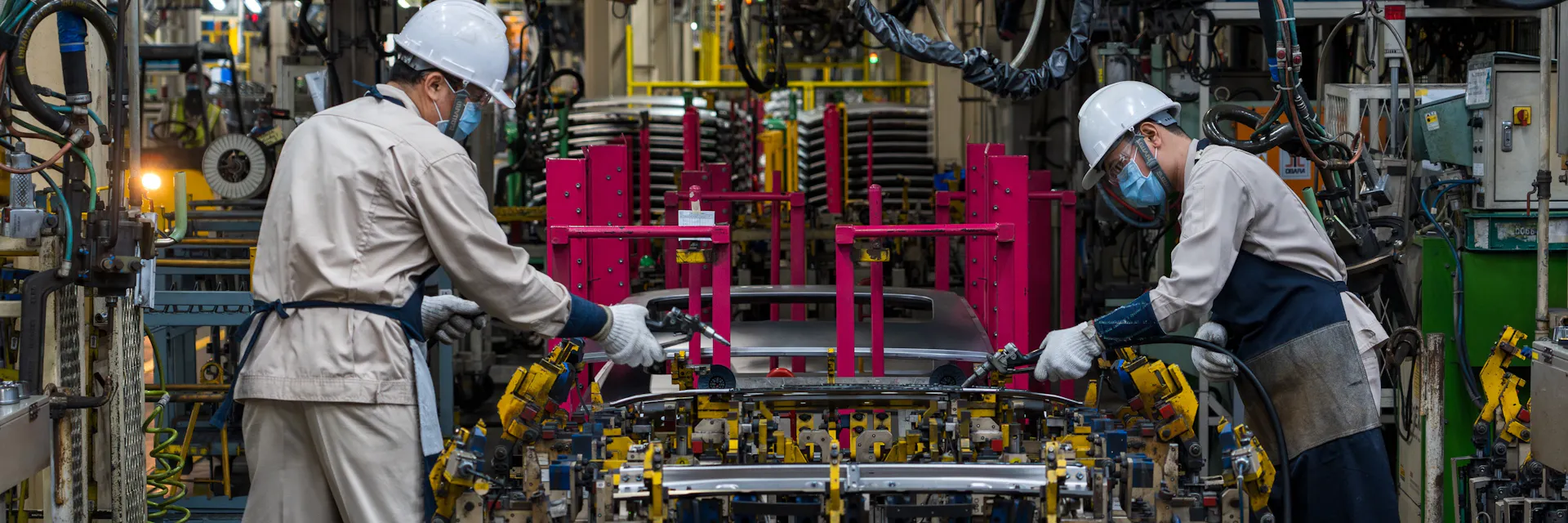
Hello and welcome to the ILO's Future of Work podcast. I'm Steve Needham. Thailand's automotive sector produces around 1.45 million vehicles each year and employs close to a million workers. But today, the industry is navigating major transformation: the shift to electric vehicles, the rise of automation and AI, and growing expectation from workers, consumers, and global markets. In this changing environment, responsible business conduct or RBC is becoming increasingly important. RBC covers many areas from environmental responsibility to
supply chain due diligence. But at its core, it also includes something more fundamental: how companies engage with workers and their representatives. In this episode, we ask how dialogue and good labour relations between management and unions can help companies remain competitive while protecting workers during a period of major transition. To explore these questions, I'm joined by Georg Leutert, Director of Automotive and Aerospace Industries at IndustriALL Global Union, a global trade union federation representing workers in mining, energy,
and manufacturing. and Satirayuth “Max” Sangsuan, Vice President of Auto Alliance Thailand, a joint venture between Ford and Mazda and one of Thailand's largest vehicle manufacturers. Georg, Max, welcome. Thanks so much and thanks for having me. Great to be with all of you today. Let's start with the basics. Georg, what does responsible business conduct mean to you? I think from a union perspective, it really means that there is a union at all. So the the company does not exclude the
workers to have a collective voice and enter into negotiations and into a constructive dialogue. That's number one. And that of course they also allow for collective agreements to be negotiated. And then finally it's everything around what I would call the democracy in the workplace. So there is continuous exchange between the parties and a common spirit of of finding solutions together to make it better. And finally there is this dimension of the society. So a factory
is not an isolated place. It is always embedded in the society and it needs to have this broader view to do good things for the society as well. And Max from an industry perspective how would you explain RBC? My understanding RBCS means cooperative, means co-creation, means productivity, means industrial peace, means win-win solutions, means sustainable labour relations. It means trust between one another. It means continued improvement, continued investment, you know,
from the parent company to AAT to the company and make us have the rapid growth and make us continue our operation in AAT in Thailand forever. This is the RBC in my view. And what does this look like day to day at Auto Alliance Thailand? When we have the the target of the production, for example this year we aim to produce 150,000 units. We share to the employees, we share to our labour union and we
break in two months that how many units that we are going to produce per month. So those sort of things that we share, we inform and we listening to the employees' voice and that kind of target we'll exchange you know with the success in terms of the objective setting back to the company. And how are you achieving this kind of collaboration? Every time when we have the labour negotiation and my senior management said that, you know, why don't we change our mindset you know from labour
negotiation to be constructive labour discussion. We have constructive discussion. So we provide the good benefit and welfare for the employees. Before we're doing that, AAT or the company is supposed to have the profit. Without any profit, we cannot provide, you know, something like, you know, the good benefit and welfare for the company. Just change the mindset you know that of the senior management that once we have the constructive labour discussion I am confident that, you know,
that both parties: management and the labour union, you know, that we're going to have the win-win approach and, you know, that both party will reach the target. The global auto industry is obviously undergoing major transformation. Georg, how important is RBC in that context? It's of tremendous importance actually, because if you look at what is happening already today in the Global North is that many, many auto workers are losing their jobs due to the introduction
of electric vehicles and which means less work right because these electric vehicles are less complex from a parts perspective. And also because there's more and more digital systems introduced etc etc. So we see like in Germany for instance over 100,000 auto jobs were lost last year and we see the same tendencies in other European countries, in the U.S., partly in Korea and in Japan, and also in in some countries of the Global South. What we also see is that companies in most
of the cases try to take quite a responsible stance where because they are willing actually to compensate the workers quite substantially from a financial perspective. But at the very end the solution of course is that these colleagues leave the company and lose their jobs. And I mean these jobs will be lost forever, right? So they will probably not come back and then I guess responsible business conduct in this context of the transformation should even mean
more, because we have to look at the society as such. And in this context I would say that it's not only about responsible compensation payments, we should particularly think about re and upskilling and try to make sure that most of these guys find a new job. And if they don't find it in the auto industry then maybe they find it in other industries which are emerging. And I think in this context we are saying to the companies – a lot of companies today particularly the auto companies – let's work together to make sure that this re and upskilling part gets much more of a
focus, of an importance than in many cases today. Max, when people hear about automation, usually the introduction of robots or co-bots, which are robots which work alongside human workers, they often think of job losses. How are you managing that transition? You know when we have, let's say when have robot, we have co-bot coming in order to help, in order to support the operation, we clearly explain to our employees that you are going to rotate to the more benefit,
to the higher responsibilities, job and responsibilities. We never say that, you know, once we have the robot, once you have the co-bot coming in, you are going to be terminated. No, we never say that. You're going to be assigned to the higher responsibilities, because you know that the more you work for companies, the higher the experience. And we need experienced people, you know, to create, to assemble the best vehicles to the customers worldwide. We need everyone. We
need all of you. We need our experienced employees working with us. We've talked about what happens inside AAT, but the automotive industry is built on vast global supply chains. Georg, is bringing stakeholders together enough? Yeah, again first of all congratulations to AAT. I think also this transparency that they create is super important. On a broader scale, we are also making quite positive experiences with multistakeholder initiatives in different contexts where we bring
together different layers of of supply chains with OEMs (original equipment manufacturer) and with unions, governments, academics or whatsoever. So overall, this is normally very positive and in many cases it can really do magic, because some countries do not have these experiences. They're not familiar with these kind of settings and in the beginning, as Max said, they're maybe not so keen to join, but then once they're there they understand that it makes a big difference to be around the table, to see each other not talk about each other but talk with each other. So that
makes a huge difference. And I think in this whole context also along supply chain due diligence, this is a super important aspect for us to follow, because these supply chains are complex and bringing the guys together is the right, I think is the right approach. But there's also one thing I think which is important – like bringing the guys together and the different stakeholders together is important and can have a value – but we also must make sure this does not end up like in a talking club with a nice atmosphere and then nothing comes out, particularly
in supply chains. I mean, let's be honest. We all know the automotive industry there is quite a hierarchy. There's the OEM, so the original equipment manufacturer, in this case AAT, that builds the cars and then there are many many many suppliers and they are on different tier levels. So there is bigger suppliers, smaller suppliers and it's a huge network of ten thousands of suppliers for each automaker. And there is also, I mean the lower you are in this supply chain, the less power you have. And what's stopping smaller suppliers from adopting this approach?
There's a lot of price pressure, cost pressure on the suppliers and it's getting, it's increasing from tier to tier. So that's one thing. And then of course, you have, the smaller the business gets you often have family business also which are maybe not so familiar, they also need training, sometimes, yeah, they also need training on existing legislation, but very often it's, they are not familiar with this. And then the cost plays a big role, and they think, like, a union will increase my cost so therefore I don't want unions. And that's, yeah, not acceptable actually
and we can do better I guess. Max, AAT has worked with ILO to help encourage companies in your supply chain to embrace RBC. How has the response been? I will say thank you to ILO Thailand that you provide, you know, that good training class, you know, not only for AAT and our labour union, but we are trying to get something like at least 20 AAT suppliers to have the same understanding,
this kind of training conducted by ILO Thailand. And we have received lots of positive feedback, you know, from our suppliers. At first they feel not comfortable when AAT invite them to to join the meeting, the training, five days of training. So our conditions, we request that you supposed to have one, at least, you know, one HR supposed to have at least one or two labour unions
working together, joining together. What kind of things do you cover in these training sessions? You learn from one another and that you just open your heart and we learn from, and we respect one another and this is one of the key successes. We are not sitting on the different side, but we are sitting together in one room, in one table. And if you could both leave one message about responsible business conduct in the automotive sector what would it be? Georg? In the current times of
transformation the most important thing is that employers and unions agree on ways to manage this transformation without everybody losing the jobs, and particularly put re and upskilling into the focus. And the other message is, I mean, there's there are super companies such as AAT, but there are also a lot of companies out there which are performing totally different. They avoid unions. They don't want to listen to their workers at all. And we've got to find ways on how to
convince these guys as well. Max? My final message, you know, that AAT management, our parents company we cannot success, you know, without our employees working with us. We have 5,000 employees and everyone are part of the key AAT success. We trust them and we need to to provide everything more transparency. We trust them and before we are doing some new policies unions are always getting involved, you know, with the company. They should know well,
they should understand and I believe that once they understand, they will support. Well that's all we have time for today. I think what stands out from this discussion is that responsible business conduct is not just about compliance or standards, it's about building trust, dialogue and shared solutions between companies and workers. And as the automotive industry undergoes rapid transformation, the real challenge is not only technological change, but how that change is managed. My thanks go to Georg Leutert and Max Sangsuan for joining us and sharing their
insights. Thanks also to you, our listeners. If you'd like to learn more about responsible business conduct and the ILO's work in this area, you can visit the ILO website at www.ilo.org. You can also stay up to date by following the ILO on social media. Our handles are @ilo on Facebook, LinkedIn, Tik Tok, and X and @ilo.org on Instagram. Once again, thank you for listening to the ILO's Future of Work podcast. Please join us again next time. Goodbye.